
Field Story | An Encounter in the Elephant Hills
Illustration by Sartaj Ghuman
A field story by Rintu Mandal, narrating a chase by an elephant in the forests of the Western Ghats during data collection for this study, published in our last Oikos “Frugivory and Seed Dispersal” Special Issue.
“Polama?”
“Polam, sir. Let’s quickly finish counting fruits on this transect and return to the field station. God knows why I am so hungry today!”
“Why don’t you just eat some Myristica fruits like the hornbills on the other transect? By the way, did you notice the Knema tree to the right of the previous bend?”
“Aama, sir. I did.”
“When do you think it will be ready for a focal watch?”
“Its fruits are still unripe, sir. It will take another month or even longer.”
“Appadiya! I see!”
Those were the last pieces of conversation between me and my field assistant, Sathiyaraj, before we were chased by a makhna, a tuskless male elephant in the Anamalai Tiger Reserve in the Western Ghats. Of course, it was a mock charge. Had it not, I might not have been alive to tell this story − for it was a close encounter, a mighty close one!
It was late in the morning on a bright sunny day in early February. The winter, although not very prominent in the Ghats, had left, but the summer had not yet arrived. That time of the year is usually quite pleasant, and was even more so in the dense evergreen forests of the southern Western Ghats, where I had been conducting my field research on avian frugivores (fruit-eating birds) over the past few months. That morning, I had finished walking a couple of transects to collect data on avian frugivores. On one of the transects that morning, I had some brilliant sightings. There were six Great Hornbills (the largest avian frugivores in Indian forests) and at least eleven Malabar Grey Hornbills (an endemic species of hornbills found in the forests of the Western Ghats) on a trail just 500 meters long. It was not just a sighting, but rather, a delightful treat to both the eyes and ears, for they were duetting, feeding on the large aril-coated Myristica (nutmeg) fruits, flying, playfully fighting with each other, and again feeding, and fighting for nearly an hour, leaving us in complete awe. Looking back, I feel that it might have been this amazement that made us a little complacent that morning. Also, neither of us had expected the elephant to be there, so close to the road, in a relatively open stretch of the forest.
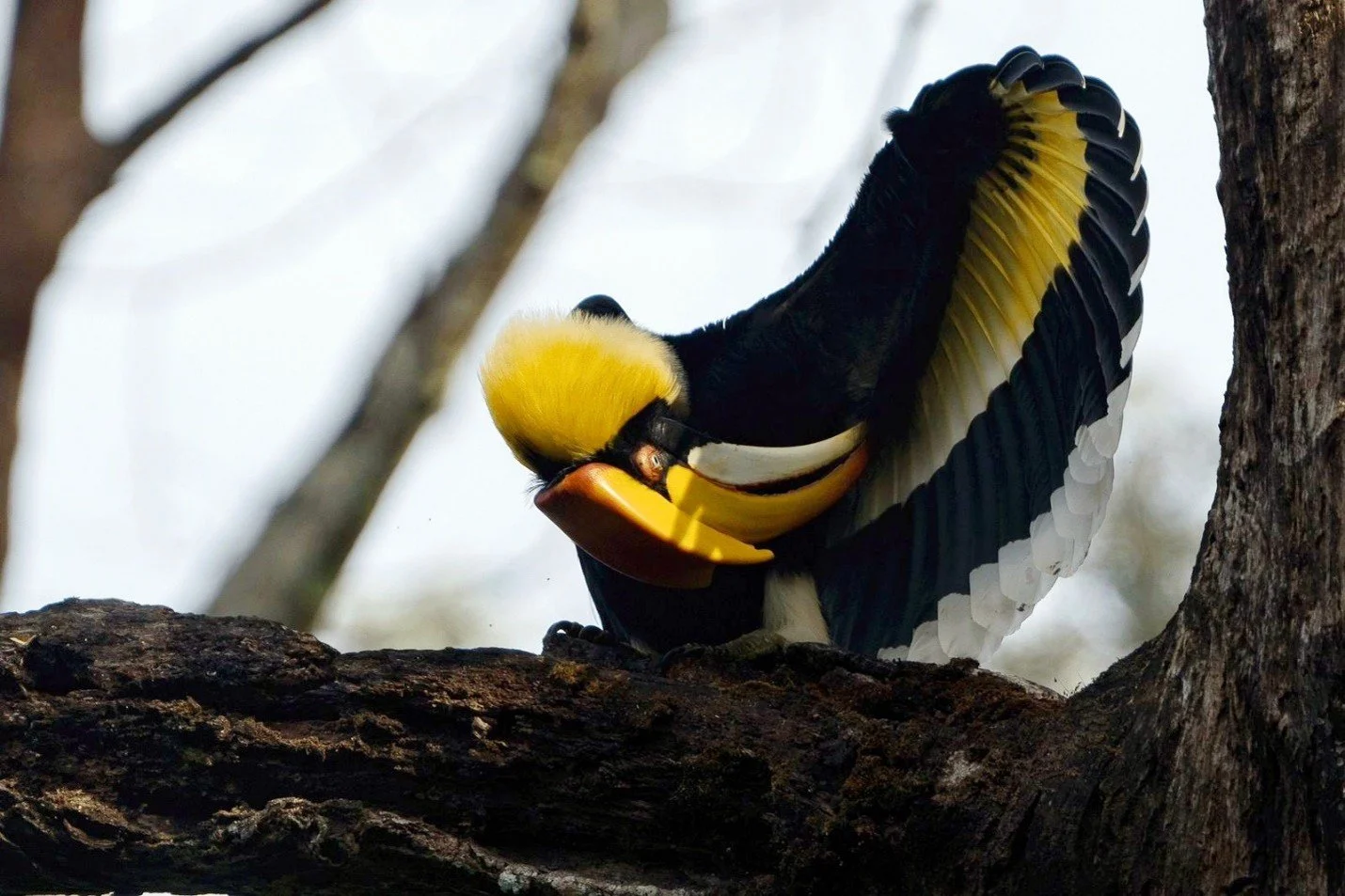
A female Great Hornbill preening. Photo by Ganesh Raghunathan.
Nevertheless, what happened that morning was that Sathiyaraj and I walked a couple of bird transects, finished counting fruits on one of them, and were on our way to count fruits on the remaining transect. We left the forest road on the right and started climbing the rocky segment of an animal trail that would lead us to the transect we were planning to go to. A few Kusum trees nearby had started shedding their leaves, creating a challenge for us to walk, as we did not know whether we were stepping on solid ground. However, we managed to walk past and reach a relatively flat surface. Sathiyaraj was walking ahead, and I was trailing him by a few meters. We were chit-chatting, as I mentioned earlier, mostly about the fruiting trees and the hornbill sightings that morning. At the same time, both of us were scanning the canopy with our binoculars to check for ripe fruits. Suddenly, there was an immediate pause in the conversation, as I heard heavy footsteps approaching me. I looked ahead only to discover Sathiyaraj sprinting towards me at the top of his speed. My whole body froze. But that was only for a moment. The next moment I was sprinting too, following him blindly. I knew exactly why we both were running, even though I saw nothing more than a big, blurred dark-grey object hurtling towards us. We ran hard; we ran for our lives. We ran past the flat ground, the Kusum trees, and the rocky slope. We were back on the road in no time and crossed it in a flash to enter the forest on the other side. The elephant stopped after a point, but we did not − not before we were convinced that we had created enough distance between that mighty fellow and us.
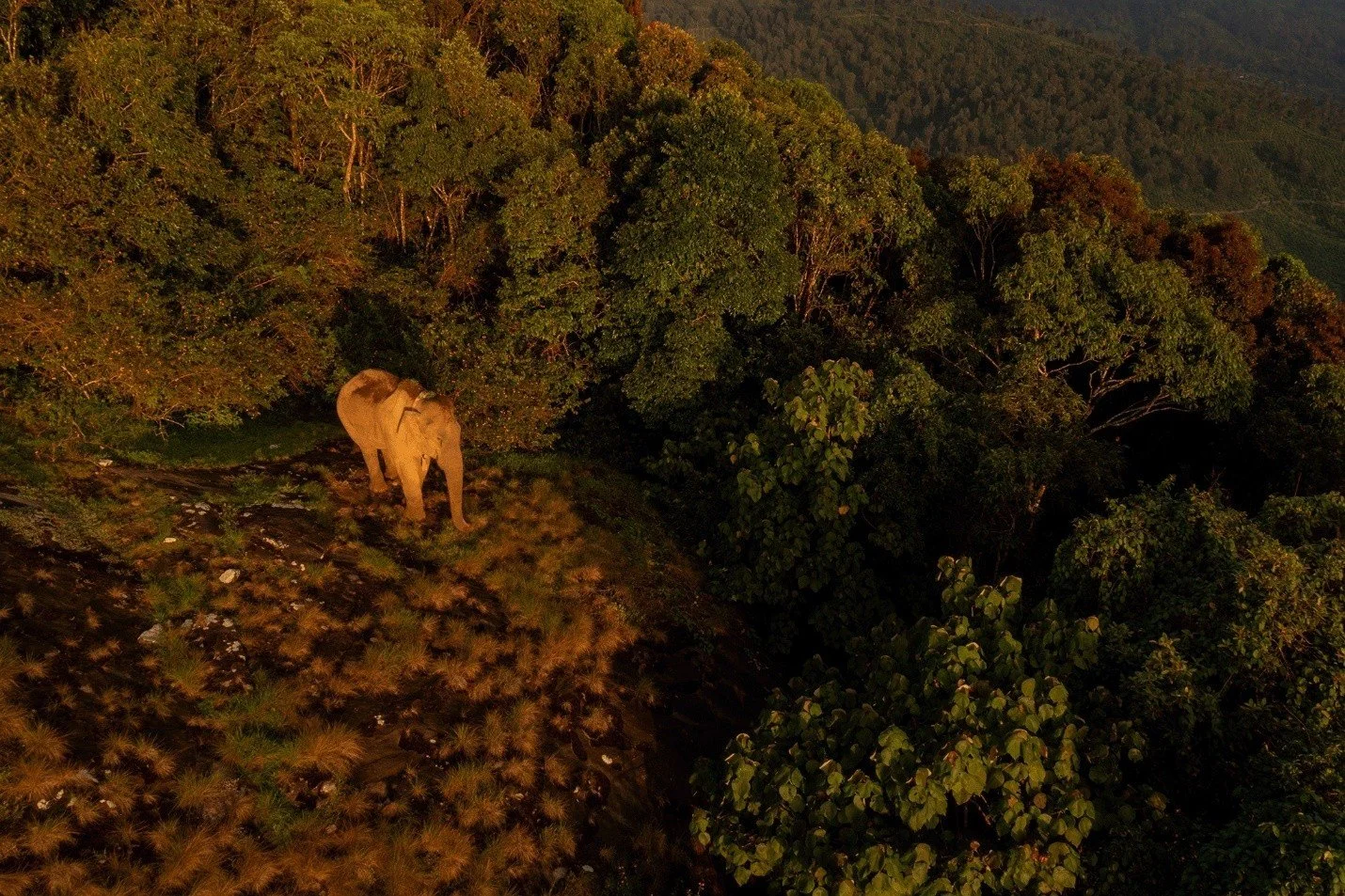
A makhna in the Anamalais. Photo by Ganesh Raghunathan.
When we finally stopped, we were completely drenched in sweat. I was gasping like a furnace, and my legs were trembling as if they were following someone else’s command. I couldn’t stand up anymore. So, I sat down under a fig tree as Sathiyaraj took his shirt off and went ahead cautiously to check the whereabouts of the makhna, with a machete and his pair of binoculars. After a couple of minutes, he came back hurriedly and informed me that we must move because the elephant was not very far away and was trying to sense our presence by putting his head down and sniffing the ground. So, we started moving deeper into the forest.
We took a long detour and reached our field station without further trouble. That was when Sathiyaraj realised he had twisted his right ankle while running away from the elephant. It had already started swelling, and he was soon limping. I took no time to take him to one of the estate hospitals, where an X-ray of his right foot was done, and to our relief, the doctor informed us that there was no major injury. We drank chai at the tea shop near the forest check post and returned to our base inside the Tiger Reserve. Not to mention that Sathiyaraj had to be in complete bed rest for the next few days before he could walk in the forests of the Elephant Hills again.
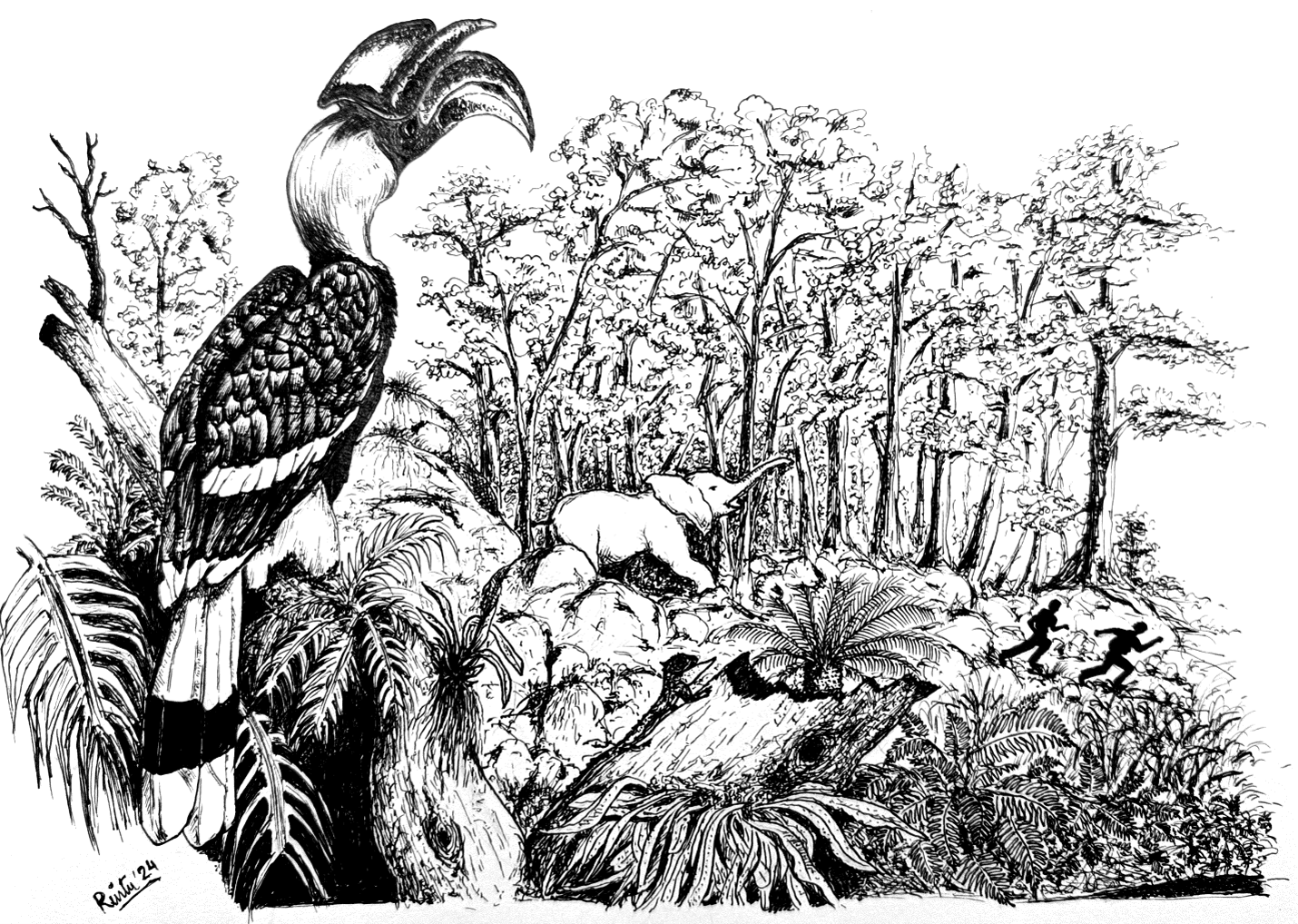
Us being chased by the elephant in the forest. Illustration by Rintu Mandal.
Oikos—who are we?

OIKOS: Advancing Ecology is a leading and longstanding journal in ecology, owned by the Nordic Society Oikos.

We publish innovative empirical and theoretical research that spans across diverse taxa, systems, and disciplines. With a focus on advancing our understanding of ecological mechanisms, processes, and patterns, Oikos fosters debate and speculation, encouraging innovative and provocative ideas that shape ecological thinking. Alongside standard Research papers and Meta-Analyses, we have unique categories of Forum, Ignite, and Dialogue papers.
Thinking about publishing with us?
Oikos offers optional sections for speculations and alternative viewpoints.
We value ethical standards in science (EDI, accessible data and code, CRediT)
Check out Oikos’s journal metrics and see our Author Guidelines
Our journals, our society—join us!
The Nordic Society Oikos engages the global scientific community through five international journals…

…and supports the national ecological societies of the five Nordic countries. Anyone worldwide can join the Nordic Society Oikos.
NSO is a home for ecologists, a nexus for knowledge, and a guiding light for ecology worldwide. We are an active network of ecologists in the Nordic region and around the globe.
Why join NSO? Membership benefits include:
Connections across a global community of ecologists and five national societies
NSO newsletters with member-only updates about Nordic ecology and society activities
Ongoing opportunities for promotion on NSO’s digital platforms and social media channels
Discounted registration for NSO’s biennial conference
Eligibility to apply for NSO Grants
Each member receives additional benefits from one of our five national societies:
Danish Oikos Society
Oikos Finland
Icelandic Ecological Society
Norwegian Ecological Society
Swedish Oikos Society
When you join NSO, you also become a member of one of our national societies. Which one? That’s up to you! Each national society provides its own benefits, including discounts to national conferences. Learn more about us at nordicsocietyoikos.org.