
Study | To clamp or not to clamp? That is the extrapolation question
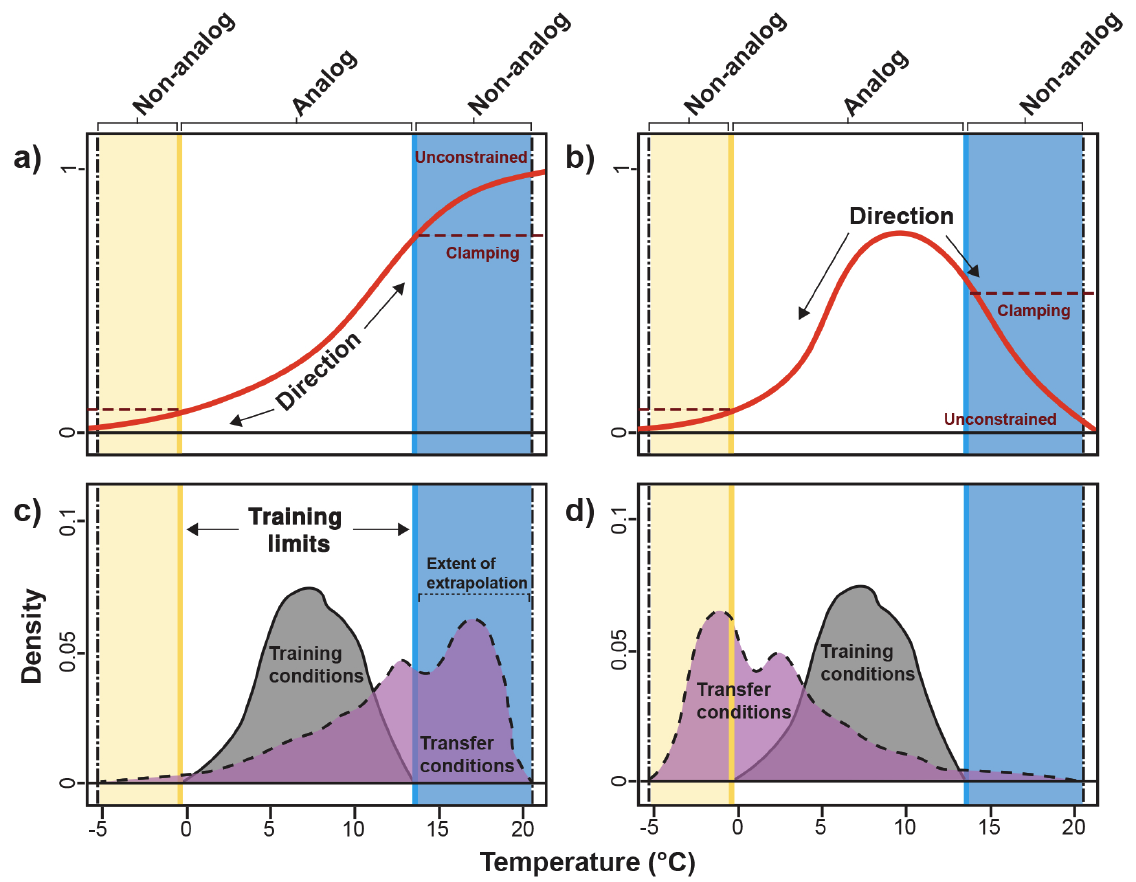
Clamped vs. unconstrained response curve tails under non-analog conditions (Fig. 1 in Pinilla-Buitrago et al. 2026)
Gonzalo E. Pinilla-Buitrago, Jamie M. Kass & Robert P. Anderson
Ecological niche models, or species distribution models, have become the most widely used method for predicting species' potential geographic ranges—and the largest use of online biodiversity data. The typical workflow involves training a model on occurrences from the species' present range. Then, the statistical relationship between the species and the environment is estimated by the model (i.e., the “model response”), and for many research objectives the model is transferred to other times (e.g., future climate change, paleodistributions) or areas (e.g., establishment risk of alien species). When the new conditions fall outside the range of environmental values represented by the training data (i.e., non-analog), the model is forced to extrapolate.
Extrapolation always adds a new layer of uncertainty: how will the model behave under non-analog conditions? To investigate this, the status quo has been to calculate metrics that measure and identify these new conditions, flagging where they are highly non-analog so we can be cautious in our interpretations. But for some algorithms (but not all!), we have the control to make decisions about how the model behaves under non-analog conditions. For example, should we allow the model to follow the estimated response into novel environmental space, or should we be more cautious and “clamp” predictions to the extreme values of the training data, resulting in static predictions regardless of how non-analog the environment becomes? Critically, these decisions can lead to extremely different results when answering questions like “how much range decline is predicted for this species under this climate change scenario?” or “how expansive was this species' distribution during the Last Glacial Maximum?” A few decisions along the way can drastically change your results. Here are some points to consider:
When transferring your model, you should decide how to handle non-analog conditions. It is imperative to explore how your model makes predictions under non-analog conditions during transfer to other places or times. This can be done by checking your model's response curve under those conditions. These decisions can also be important when evaluating a model during training because extrapolation can occur even during cross-validation (especially for partitioning methods that make groups more different environmentally).
Clamping is not always the best option. It's tempting to assume clamping is always the "safest" choice, but that's not true. Clamping freezes the prediction to that of the training limit, even if the direction of the modeled response was decreasing. For example, if left unconstrained, the model might actually predict lower suitability the more you push past that limit, but clamping would hold the prediction high, regardless of which direction the response was heading.
A variable that is responsible for high non-analog values may not be contributing to your model. Depending on the algorithm, some variables can be dropped from the model during training (e.g., via regularization), and those excluded variables could be the ones driving highly non-analog values in environmental similarity metrics that identify areas with high extrapolation risk (e.g., MESS, MOP). So, it's a good idea to subset your variables to the ones used by the model when calculating similarity metrics.
It may be better to apply custom clamping rather than make a blanket decision (clamping versus unconstrained extrapolation). For some algorithms, such as Maxent, the choice of extrapolation strategy doesn't have to be black-and-white. When checking the individual response curves under non-analog conditions, clamping may be better for some curves but not all—or one tail but not the other. So why not make an informed decision for each variable tail separately?
In some situations, the choice of extrapolation strategy doesn't matter much. For example, this happens when clamping and unconstrained extrapolation give essentially the same result under non-analog environmental conditions, or when the choice between the two is irrelevant because so few pixels have non-analog values.
To make more informed decisions regarding extrapolation strategy, we developed a new workflow, along with visualization tools available in the R package ENMeval (v2.0.6). These tools will help you understand how your model is making predictions under non-analog conditions, find the most suitable extrapolation strategy for the particular non-analog conditions in your study system, and ultimately make more informed and realistic decisions when transferring your model. As a worked example, we put this workflow to the test on the Mexican black-eared mouse, hindcasting its potential distribution back to the Last Glacial Maximum under two different reconstructions of past climate. Custom clamping led to more ecologically realistic predictions than either indiscriminate unconstrained extrapolation or blanket clamping across all variables.
To answer the Shakespearean modeling question—to clamp or not to clamp—and to get more detail on our proposed workflow, visualization tools, and worked example, check out our recent paper in Ecography: https://doi.org/10.1002/ecog.08590
For Spanish speakers and enthusiasts, a complete translation of the manuscript is available on Zenodo: https://zenodo.org/records/22284052
Ecography—who are we?

ECOGRAPHY: A Journal of Space and Time in Ecology is an Open Access journal owned by the Nordic Society Oikos.

Our journal strives to understand ecological or biodiversity patterns through space and time. We encourage papers to advance the field of macroecology and biogeography through the development and testing of theory or modern methodology (remote sensing, molecular techniques, AI) or by proposing new tools for analysis or interpretation of ecological phenomena. There are no biases with regard to taxon, biome, or biogeographical area.
Thinking about publishing with us?
Ecography offers an annual E4 Award for early-career researchers
We value ethical standards in science (EDI, Open Access, waivers, accessible data and code, CRediT)
Check out Ecography’s journal metrics and see our Author Guidelines
Our journals, our society—join us!
The Nordic Society Oikos engages the global scientific community through five international journals…

…and supports the national ecological societies of the five Nordic countries. Anyone worldwide can join the Nordic Society Oikos.
NSO is a home for ecologists, a nexus for knowledge, and a guiding light for ecology worldwide. We are an active network of ecologists in the Nordic region and around the globe.
Why join NSO? Membership benefits include:
Connections across a global community of ecologists and five national societies
NSO newsletters with member-only updates about Nordic ecology and society activities
Ongoing opportunities for promotion on NSO’s digital platforms and social media channels
Discounted registration for NSO’s biennial conference
Eligibility to apply for NSO Grants
Each member receives additional benefits from one of our five national societies:
When you join NSO, you also become a member of one of our national societies. Which one? That’s up to you! Each national society provides its own benefits, including discounts to national conferences. Learn more about us at nordicsocietyoikos.org.
Danish Oikos Society
Oikos Finland
Icelandic Ecological Society
Norwegian Ecological Society
Swedish Oikos Society