
November/December Cover
Photo by Ilse Storch
Download the high-resolution image
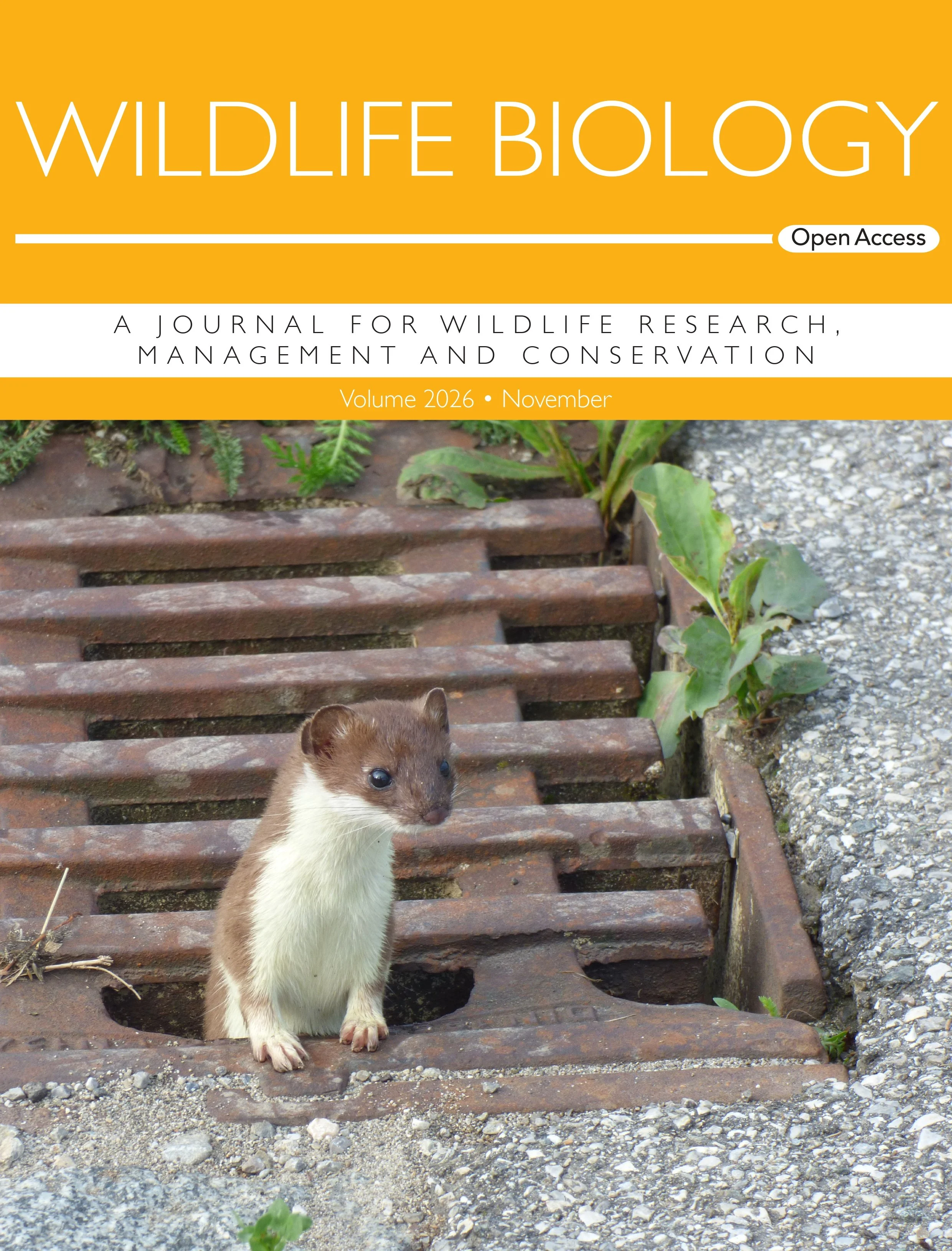
This cover features a stoat (Mustela erminea) peeping out from a gully cover in a village in southern Germany, offering a glimpse of wildlife in an urban environment.
Such encounters demonstrate the species’ adaptability and the ecological value of urban habitats, where even the drainage system can provide shelter, movement corridors, and opportunities for foraging.
Find the special issue ‘Urban Wildlife’ here: https://nsojournals.onlinelibrary.wiley.com/doi/toc/10.1002/(ISSN)1903-220X.urban-wildlife
From the editorial:
The current trends in urbanisation vary across cities and geographic regions (Seto et al. 2013, Zhang 2016) and are creating distinct ecological consequences for urban wildlife (i.e. animals living freely in cities alongside humans) worldwide.
Given these conditions, urban wildlife has gained significant attention in the 21st century (Magle et al. 2012, Elmqvist 2013, Rodewald and Stanley 2014, Collins et al. 2021, Sultana et al. 2023).
There is an increasing focus on understanding the patterns and drivers of urban wildlife distributions, linking species behaviour, landscape ecology, conservation and management issues across rural–urban gradients.
Read more about the editorial and find the references here: https://nsojournals.onlinelibrary.wiley.com/doi/10.1002/wlb3.01773
Wildlife Biology—who are we?
WILDLIFE BIOLOGY: Journal for Wildlife Research, Management, and Conservation is an Open Access journal owned by the Nordic Society Oikos.
Our journal promotes a scientific basis for the conservation and management of wildlife and human-wildlife relationships. We adopt a broad concept of wildlife management to safeguard sustainable relationships between wildlife and other human interests. This includes all policies and actions with the purpose of conservation, sustainable use, or control of wildlife and its habitats. We welcome theoretical, empirical, and practical articles from all areas of wildlife science.
Thinking about publishing with us?
Wildlife Biology publishes research, review, and management Articles as well as short Communications.
We value ethical standards in science (EDI, Open Access, waivers, accessible data and code, CRediT)
Check out Wildlife Biology’s journal metrics and see our Author Guidelines
Our journals, our society—join us!
The Nordic Society Oikos engages the global scientific community through five international journals…
…and supports the national ecological societies of the five Nordic countries. Anyone worldwide can join the Nordic Society Oikos.
NSO is a home for ecologists, a nexus for knowledge, and a guiding light for ecology worldwide. We are an active network of ecologists in the Nordic region and around the globe.
Why join NSO? Membership benefits include:
Connections across a global community of ecologists and five national societies
NSO newsletters with member-only updates about Nordic ecology and society activities
Ongoing opportunities for promotion on NSO’s digital platforms and social media channels
Discounted registration for NSO’s biennial conference
Eligibility to apply for NSO Grants
Each member receives additional benefits from one of our five national societies:
Danish Oikos Society
Oikos Finland
Icelandic Ecological Society
Norwegian Ecological Society
Swedish Oikos Society
When you join NSO, you also become a member of one of our national societies. Which one? That’s up to you! Each national society provides its own benefits, including discounts to national conferences. Learn more about us at nordicsocietyoikos.org.