
New Editor | Verónica Méndez Aragón, subject editor for JAB
Warmly welcome to the editorial board of Journal of Avian Biology - Verónica Méndez Aragón!
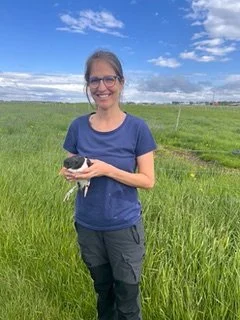
Verónica with an oystercatcher.
Verónica Méndez Aragón is a shorebird expert working on migration, breeding ecology and conservation. She is based at the University of Iceland.
Read the short interview with Veronica below and learn more about her research and her interests.
What's your main research focus at the moment?
At the moment, my colleagues and I at the South Iceland Research Centre, University of Iceland, are investigating how juvenile migratory behaviour develops in three Icelandic shorebird species: Eurasian oystercatcher, black-tailed godwit and whimbrel. We aim to understand how individual differences in migratory behaviour relate to population-level changes in phenology, demography and distribution.
Although much of my research focuses on migration and its individual-level consequences, my heart also lies with conservation. I am involved in several projects aiming to understand the spatial distribution of Icelandic breeding birds, how these bird communities are changing over time, and how this information can be used to inform conservation efforts.
Can you describe your research career? Where, what, when?
I completed my PhD at the University of East Anglia in 2012, investigating spatial and temporal variation in the functional diversity of non-breeding shorebird communities in the UK. It was during my time at UEA that I was first introduced to the wonderful world of migratory birds and also visited Iceland for the first time. It was love at first sight! Following my PhD, I worked as a research ecologist at the British Trust for Ornithology for about two years, but my heart and mind were still in Iceland, and particularly with its incredible migratory shorebirds. Eventually, we decided to develop a project investigating how individual birds respond to environmental change, with a particular focus on variation in migratory behaviour and its associated fitness consequences in a population of Eurasian oystercatchers breeding in Iceland. The project was funded in 2015, and I have been working primarily with this species ever since – there is still a lot to learn!
How come that you became a scientist with an interest in birds?
When I applied for my PhD, my main interests were broadly in biodiversity and community-level processes. I was trained as a marine biologist and had worked on several conservation projects around the world, as well as conducting research on community-level processes using macroalgae as a model system. But during my PhD, I met some wonderful colleagues and friends whose enthusiasm for birds and migration was highly contagious. I guess that's how it all started: a young community ecologist finding her way into, and being warmly embraced by, the bird community.
Enough about work: what do you do when you're not working?
I became a mum three years ago, so a lot of my "free" time is now spent with my family. Having a toddler has given me the opportunity to see the world through a different pair of eyes and rediscover how beautiful the simple things in life can be. There's never a dull moment! We live in a fast-paced world, so I try to slow things down and make time for yoga, nature walks, and catching up with friends and family.
Journal of Avian Biology—who are we?
JOURNAL of AVIAN BIOLOGY: Empirical and Theoretical Research in Ornithology is an Open Access journal owned by the Nordic Society Oikos.
We are a journal for innovative, hypothesis-driven research on the biology of birds, with a particular emphasis on ecological, evolutionary and behavioural studies. We welcome submissions that study avian biology across all levels of ecological organization, from organisms and populations to communities and ecosystems. The journal also welcomes studies that report negative results, provided they are conducted rigorously and are scientifically informative. As a Nordic Society Oikos journal, we advocate research that is fair, openly accessible and reproducible.
Thinking about publishing with us?
Journal of Avian Biology offers a Review Award for early-career researchers.
We value ethical standards in science (EDI, Open Access, waivers, accessible data and code, CRediT)
Check out JAB’s journal metrics and see our Author Guidelines
Our journals, our society—join us!
The Nordic Society Oikos engages the global scientific community through five international journals…

…and supports the national ecological societies of the five Nordic countries. Anyone worldwide can join the Nordic Society Oikos.
NSO is a home for ecologists, a nexus for knowledge, and a guiding light for ecology worldwide. We are an active network of ecologists in the Nordic region and around the globe.
Why join NSO? Membership benefits include:
Connections across a global community of ecologists and five national societies
NSO newsletters with member-only updates about Nordic ecology and society activities
Ongoing opportunities for promotion on NSO’s digital platforms and social media channels
Discounted registration for NSO’s biennial conference
Eligibility to apply for NSO Grants
Each member receives additional benefits from one of our five national societies:
Danish Oikos Society
Oikos Finland
Icelandic Ecological Society
Norwegian Ecological Society
Swedish Oikos Society
When you join NSO, you also become a member of one of our national societies. Which one? That’s up to you! Each national society provides its own benefits, including discounts to national conferences. Learn more about us at nordicsocietyoikos.org.