
Cover | Fear Shapes the Forest
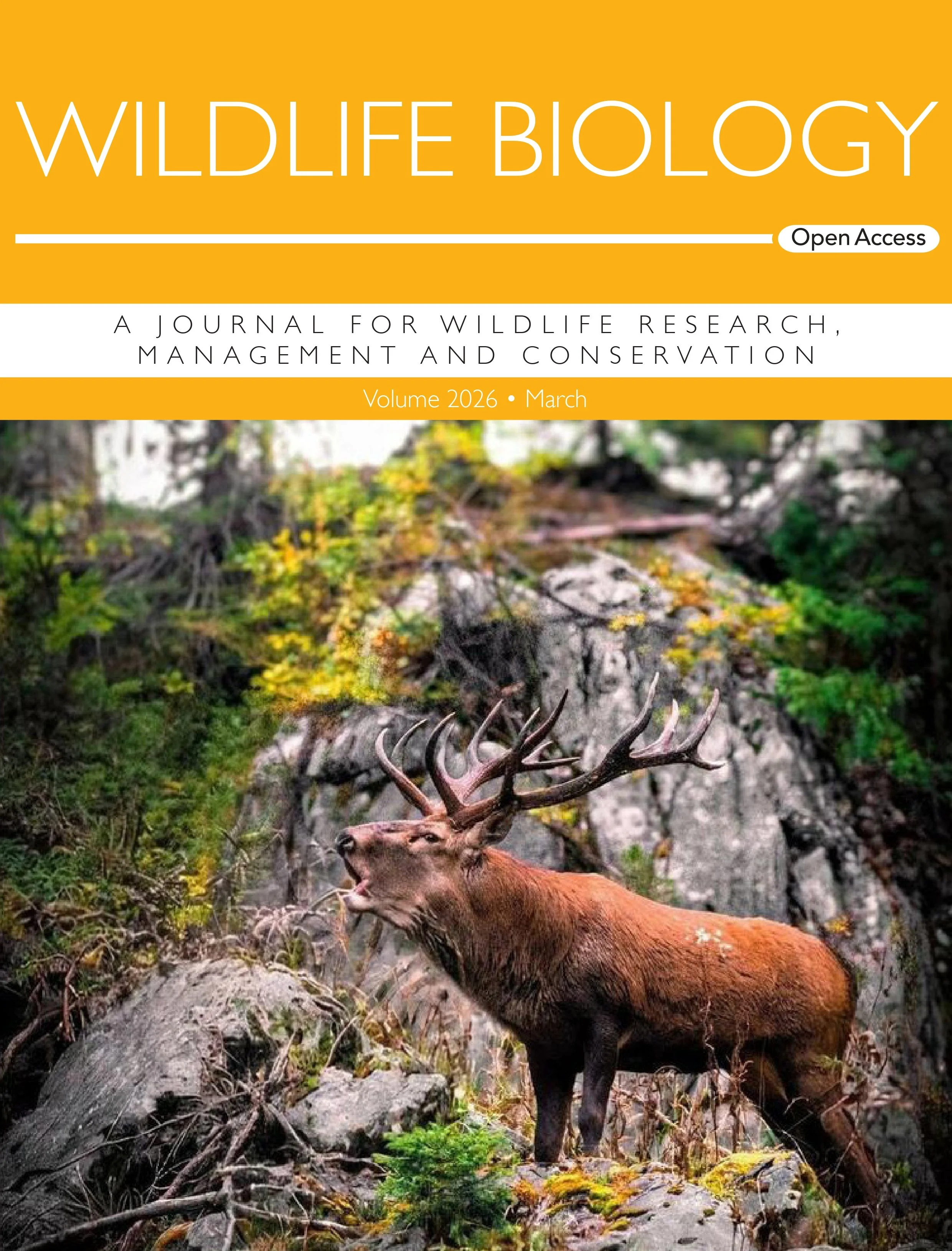
March/April Cover
Photo by Rudolf Reiner
Download the high-resolution image
The photo features a male red deer (Cervus elaphus) in the heterogeneous landscape of Berchtesgaden National Park, its behaviour shaped by hunting pressure and habitat structure.
Read the full open access paper by Eggers et al. (2026): Navigating a landscape of contrasting hunting regimes and habitats: red deer responses to risk and resources
From the abstract:
Habitat selection of ungulates is influenced by various factors, with human interactions playing a significant role. Human disturbances through hunting strongly affect ungulate behaviour, often forcing them to modify their habitat choices by avoiding areas where the risk from humans outweighs other habitat benefits. Gaining insights into these dynamics of human-wildlife interactions is essential for reducing conflicts between hunting objectives and wildlife conservation efforts.
Here, we used GPS tracking data of 32 female red deer Cervus elaphus to derive resource selection functions, analysing habitat selection of animals with both hunting and no-hunting zones within their home range in Berchtesgaden National Park, Germany.
Red deer habitat selection differed distinctly between hunting and no-hunting zones. In the hunting zone, red deer more strongly selected closed forests, indicating a priority for safety. This pattern was particularly strong during daylight hours (i.e. the primary time of hunting) during which they also greatly reduced their movement. During night-time, when hunting risk was absent, red deer strongly selected open habitats and increased their movement rate. Conversely, red deer consistently selected open habitats and had similar movement rates during both day and night in the no-hunting zone, reflecting a preference for foraging grounds when not influenced by hunting. Our results highlight red deer's ability to distinguish between and adapt to areas of varying risk within their home range.
These insights are critical for targeted wildlife management and conservation. On the one hand, they demonstrated that hunting can be strategically used as a management tool to control red deer habitat use, reducing their presence and thus potentially their impact on specific areas. On the other hand, the finding that hunting distinctly influences red deer habitat selection and movement highlights the value of no-hunting zones for the conservation of natural behaviour of ungulate populations.
Wildlife Biology—who are we?
WILDLIFE BIOLOGY: Journal for Wildlife Research, Management, and Conservation is an Open Access journal owned by the Nordic Society Oikos.
Our journal promotes a scientific basis for the conservation and management of wildlife and human-wildlife relationships. We adopt a broad concept of wildlife management to safeguard sustainable relationships between wildlife and other human interests. This includes all policies and actions with the purpose of conservation, sustainable use, or control of wildlife and its habitats. We welcome theoretical, empirical, and practical articles from all areas of wildlife science.
Thinking about publishing with us?
Wildlife Biology publishes research, review, and management Articles as well as short Communications.
We value ethical standards in science (EDI, Open Access, waivers, accessible data and code, CRediT)
Check out Wildlife Biology’s journal metrics and see our Author Guidelines
Our journals, our society—join us!
The Nordic Society Oikos engages the global scientific community through five international journals…
…and supports the national ecological societies of the five Nordic countries. Anyone worldwide can join the Nordic Society Oikos.
NSO is a home for ecologists, a nexus for knowledge, and a guiding light for ecology worldwide. We are an active network of ecologists in the Nordic region and around the globe.
Why join NSO? Membership benefits include:
Connections across a global community of ecologists and five national societies
NSO newsletters with member-only updates about Nordic ecology and society activities
Ongoing opportunities for promotion on NSO’s digital platforms and social media channels
Discounted registration for NSO’s biennial conference
Eligibility to apply for NSO Grants
Each member receives additional benefits from one of our five national societies:
Danish Oikos Society
Oikos Finland
Icelandic Ecological Society
Norwegian Ecological Society
Swedish Oikos Society
When you join NSO, you also become a member of one of our national societies. Which one? That’s up to you! Each national society provides its own benefits, including discounts to national conferences. Learn more about us at nordicsocietyoikos.org.