
Study | Targeting Conservation for First Migrations
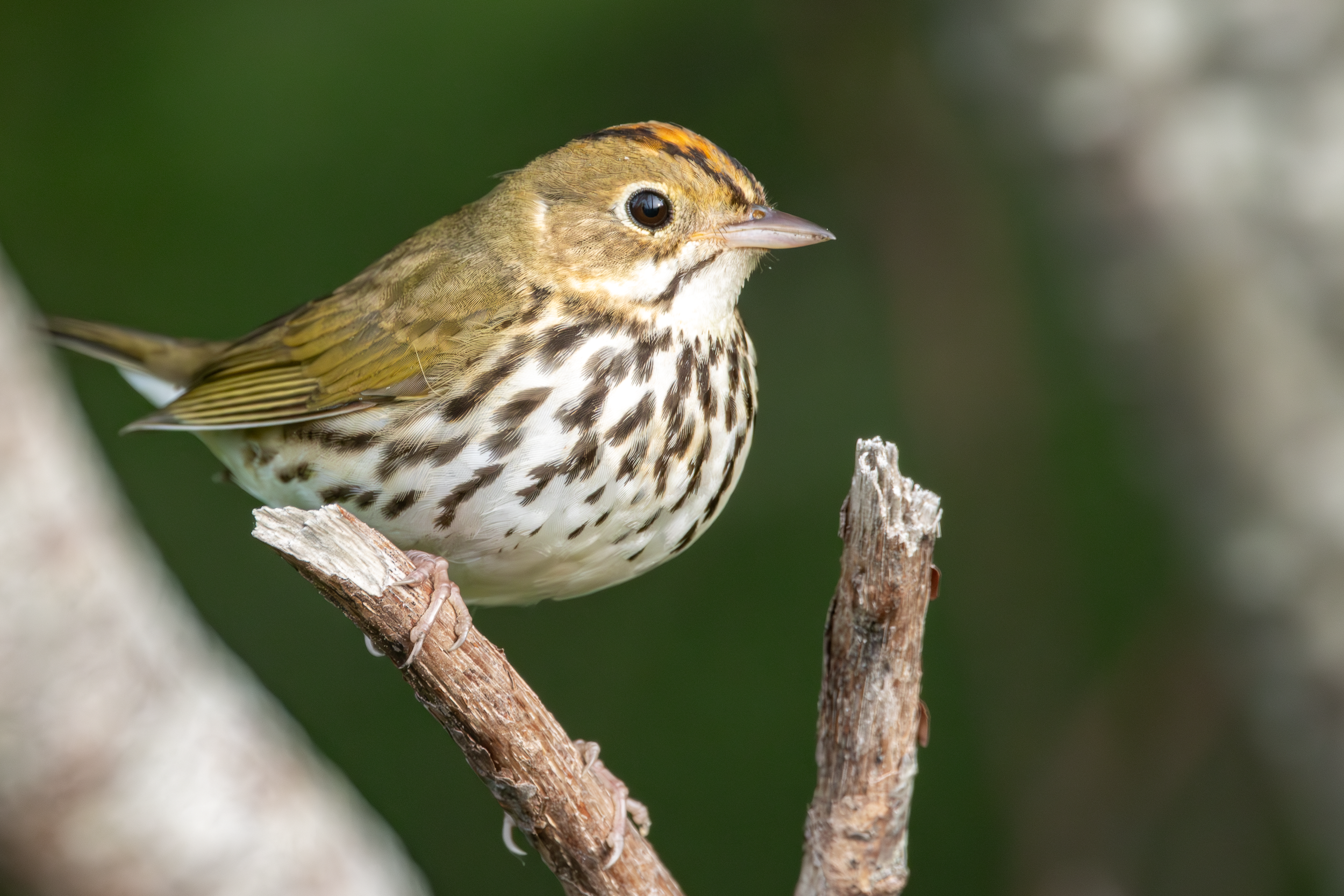
Figure 1. Young Ovenbird in a branch.
Consider a young Ovenbird (Figure 1), hatched only weeks prior in a nest in coastal Maine. Weighing no more than a few paperclips, this tiny bird must now begin a cross-continental journey spanning thousands of kilometers through an unfamiliar landscape.
Throughout the world, each spring and fall, billions of birds complete these incredible movements between distant nesting and wintering grounds to access season fluxes of resources and maximize their fitness. But, due to a multitude of threats and stressors, populations of avian migrants have declined widely and are now the focus of widespread conservation action.
In short: Understanding how these young birds migrate is key to protecting them
However, migration occurs at continental scales, and the funding and workforce available to implement conservation action is vastly limited by comparison. Identifying strategies that may allow for more targeted approaches to conserve these imperiled populations are needed to increase the impact of our actions. Juvenile migrants, birds on their first migration, have low survival rates, and their survival is key to overall population trajectories. Therefore, identifying ways to focus conservation efforts on increasing the survival of juveniles during migration may be of conservation benefit. But how can we focus efforts on juveniles?
What did we do?
We used five decades of bird banding data, representing over 6 million banding encounters, to explore how widespread variability in migration speed and timing between age classes and across species might lead to spatiotemporal shifts in the age structure of the migrant community. Specifically, we assessed whether the proportion of juveniles within the community shifts throughout fall migration.
We found that:
Age structure of the migrant community shifts broadly throughout the migration season, with the proportion of juveniles within the population varying through space and time. Using this information, we can identify time periods and locations in which the proportion of juveniles is highest in the community and recommend these locations and times for targeted conservation actions.
Not only did we find that migrant community age structure shifts within a single fall migration season, but we also found that the age structure of the community has shifted over the last 53 years, with unknown consequences. A growing body of work is demonstrating that sociality may play an important role in avian migration ecology and could impact decision making and survival for individuals. In other migration systems, knowledge shared from adults to juveniles is key to the success of those juveniles in migration.
Location and sociability is key for their first migration
Our work indicates that in avian migrants the number of adults from which juveniles may gather information varies within a migration season and has declined at large scales in recent decades. As research of the sociality of nocturnal avian migrants moves forward, understanding how migrants of different age-classes interact, how those interactions may be impacted by shifting community age structure, and how the combination of these factors may impact the survival of juveniles will be informative for our understanding of migration behavior, ecology, and conservation.
Ecography—who are we?

ECOGRAPHY: A Journal of Space and Time in Ecology is an Open Access journal owned by the Nordic Society Oikos.

Our journal strives to understand ecological or biodiversity patterns through space and time. We encourage papers to advance the field of macroecology and biogeography through the development and testing of theory or modern methodology (remote sensing, molecular techniques, AI) or by proposing new tools for analysis or interpretation of ecological phenomena. There are no biases with regard to taxon, biome, or biogeographical area.
Thinking about publishing with us?
Ecography offers an annual E4 Award for early-career researchers
We value ethical standards in science (EDI, Open Access, waivers, accessible data and code, CRediT)
Check out Ecography’s journal metrics and see our Author Guidelines
Our journals, our society—join us!
The Nordic Society Oikos engages the global scientific community through five international journals…

…and supports the national ecological societies of the five Nordic countries. Anyone worldwide can join the Nordic Society Oikos.
NSO is a home for ecologists, a nexus for knowledge, and a guiding light for ecology worldwide. We are an active network of ecologists in the Nordic region and around the globe.
Why join NSO? Membership benefits include:
Connections across a global community of ecologists and five national societies
NSO newsletters with member-only updates about Nordic ecology and society activities
Ongoing opportunities for promotion on NSO’s digital platforms and social media channels
Discounted registration for NSO’s biennial conference
Eligibility to apply for NSO Grants
Each member receives additional benefits from one of our five national societies:
When you join NSO, you also become a member of one of our national societies. Which one? That’s up to you! Each national society provides its own benefits, including discounts to national conferences. Learn more about us at nordicsocietyoikos.org.
Danish Oikos Society
Oikos Finland
Icelandic Ecological Society
Norwegian Ecological Society
Swedish Oikos Society