
*Study | Overcoming technological constraints in the tracking of small, elusive birds
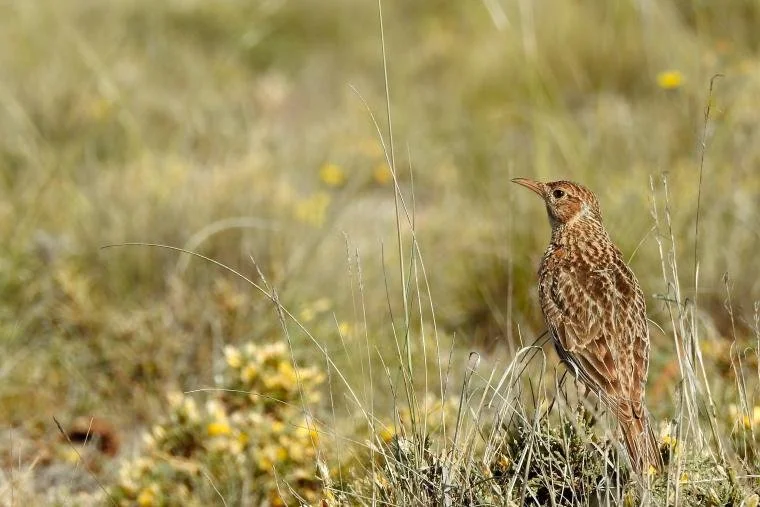
Photo above: Dupont's lark Chersophilus duponti. Photo credit: Adrian Barrero.
Advances in GPS and biologging technology have greatly enhanced our understanding of wildlife ecology, providing valuable data on movement, habitat use, behaviour, and biological rhythms. However, the use of such devices remains largely limited to relatively large species due to weight constraints. Although progress has allowed smaller birds to be tracked, GPS tags with remote download capabilities are still unavailable for the lightest species (under 40 g), leaving nearly 50% of bird species beyond the scope of remote telemetry. For these cases, archival GPS loggers—without GSM or remote access—remain the only option, requiring physical retrieval. This is particularly difficult when studying cryptic, elusive species or individuals with prior trapping experience.
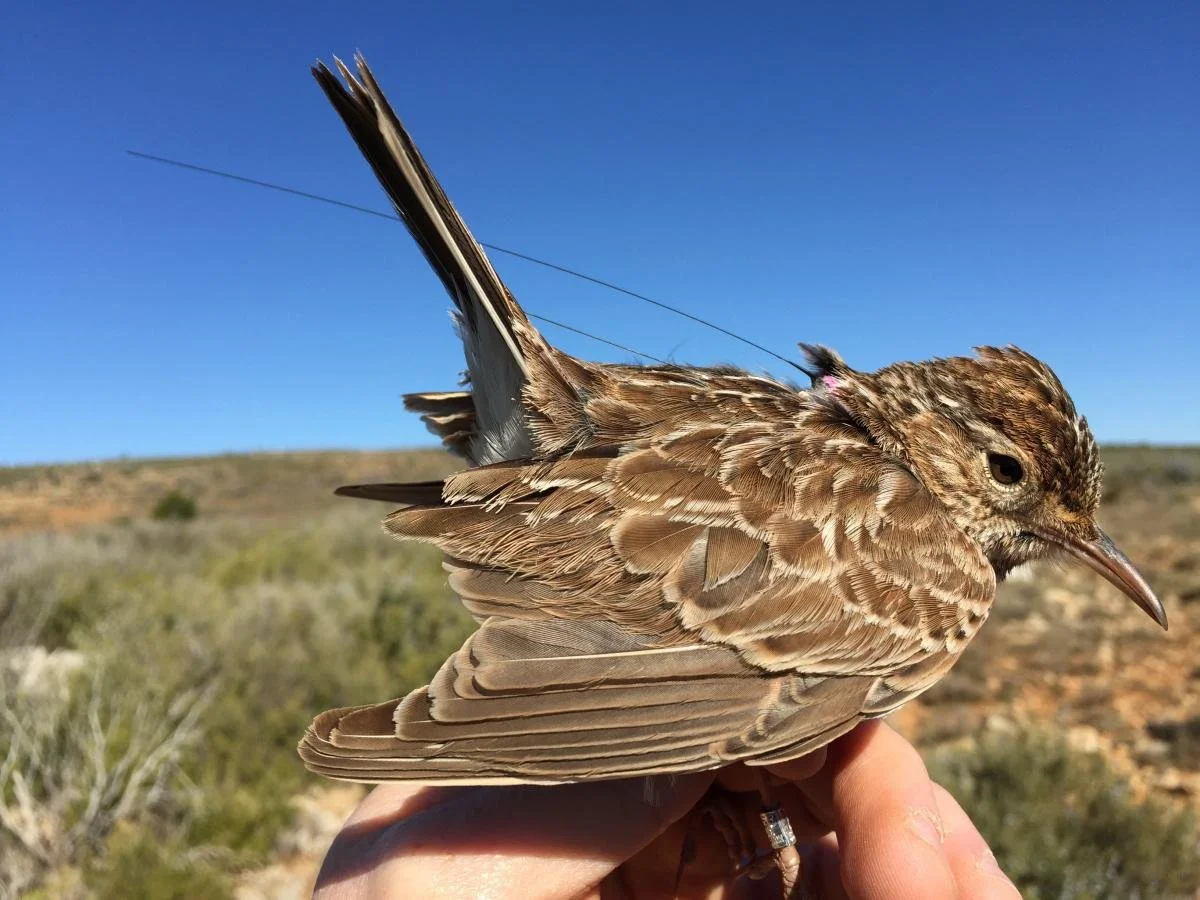
Dupont's lark fitted with a GPS/VHF tag. Photo: Pedro Saez Gomez
In our study, we used Dupont’s lark (Chersophilus duponti) as a model species to test a lightweight, efficient tracking method combining GPS and VHF technology. We deployed a water-soluble backpack harness that allows device retrieval without the need for recapture. Our design ensured drop-off following rainfall, with no impact on body weight or survival. We recommend mounting the VHF tag at a 45º angle to optimise signal function while preserving GPS accuracy. This method reduces field effort, lowers stress for birds, and enables device reuse, offering a promising tool for small bird telemetry and broader conservation applications.
A full video tutorial demonstrating the assembly and rain-triggered release mechanism is available below:
Text and video by Pedro Sáez-Gómez (pedro.saez@uam.es)
Ecology Department / IMEM ‘Ramón Margalef’, University of Alicante, Alicante, Spain.
Terrestrial Ecology Group (TEG-UAM), Department of Ecology, Universidad Autónoma de Madrid, Madrid, Spain.
More News from JAB
Journal of Avian Biology is an Open Access journal for innovative research on bird biology, with an emphasis on ecological, evolutionary, and behavioral studies. We welcome submissions that study avian biology across all levels of ecological organization, from organisms and populations to communities and ecosystems. As a Nordic Society Oikos journal, we advocate research that is fair and openly accessible. Learn more about JAB.
More News from NSO Journals
The Nordic Society Oikos publishes five international journals—Oikos, Ecography, Journal of Avian Biology, Wildlife Biology, and Nordic Journal of Botany—and supports the national ecological societies of the five Nordic countries. Learn more about the Nordic Society Oikos and the NSO Journals.