
*Study | Mechanisms matching timing to resources: comparisons of closely related seasonally sympatric, migratory and non-migratory populations
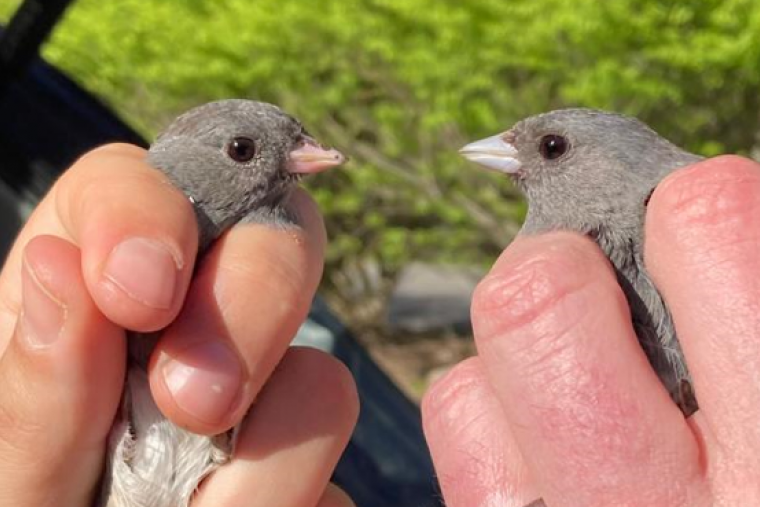
Photo above: migrant and resident dark-eyed juncos in the hand showing variation in bill color, migrant on the left, resident on the right. Photo by Maria Stager.
The climate is warming, and many bird species are keeping up by altering when they migrate, breed, and molt, that is, by altering their phenology. To make accurate predictions about future responses to climate warming, knowledge of the mechanisms regulating timing is needed. How flexible is phenology? How readily might it respond to selection?
In the temperate zone, reproduction is stimulated by seasonal increases in day length. Populations are known to vary in their photoperiodic thresholds, the minimum day length required to initiate gonadal growth. In their recent paper, Ketterson & Greives reviewed studies comparing photoperiodic thresholds, endocrine profiles of testosterone and corticosterone, and gene expression during pre-breeding in seasonally sympatric migratory and resident populations of a songbird, the dark-eyed junco (Junco hyemalis). Junco populations differ in where they breed and whether they migrate.
Junco populations that breed at higher latitudes typically move to lower latitudes for the winter where they may coexist with resident populations that do not migrate. They compared timing mechanisms of migrants and residents living in the same pre-breeding photoperiodic environment as days lengthened in early spring. They found that migrants fattened and delayed gonadal development, while residents initiated gonadal development while not fattening.
Within the migrants, latitude of origin (estimated using stable isotopes) co-varied positively with migratory fattening and negatively with gonadal development. That is, migrant individuals scheduled to return to higher latitudes prior to reproducing fattened more and delayed gonadal growth longer as compared to migrants that breed at lower latitudes.
Together these mechanisms likely serve to match timing of migration and reproduction to the seasonal appearance of resources where breeding will occur. Importantly, differences observed in the wild persisted in a common environment, suggesting genetic divergence and local adaptation in thresholds and fattening, although the possibility of early developmental effects on timing remain. Collectively the studies reviewed point to geographic variation in timing that has a genetic component on which selection can be expected to act as the climate continues to change.
Learn more about the juncos at Mountain Lake Biological Station near Pembroke, VA USA:
The paper in Journal of Avian Biology also refers to research done in California, about which you can learn more in the video below:
The middle of a bustling college campus is not your typical Junco breeding habitat. So when a small population of Juncos began breeding in the urban and coastal habitat of the UCSD campus, researchers took note–documenting how the new environment is rapidly altering their biology.
More News from JAB
Journal of Avian Biology is an Open Access journal for innovative research on bird biology, with an emphasis on ecological, evolutionary, and behavioral studies. We welcome submissions that study avian biology across all levels of ecological organization, from organisms and populations to communities and ecosystems. As a Nordic Society Oikos journal, we advocate research that is fair and openly accessible. Learn more about JAB.
More News from NSO Journals
The Nordic Society Oikos publishes five international journals—Oikos, Ecography, Journal of Avian Biology, Wildlife Biology, and Nordic Journal of Botany—and supports the national ecological societies of the five Nordic countries. Learn more about the Nordic Society Oikos and the NSO Journals.