
New editor | Paul Dufour, subject editor for JAB
Paul Dufour joins Journal of Avian Biology’s Editorial Board as a subject editor. Welcome!
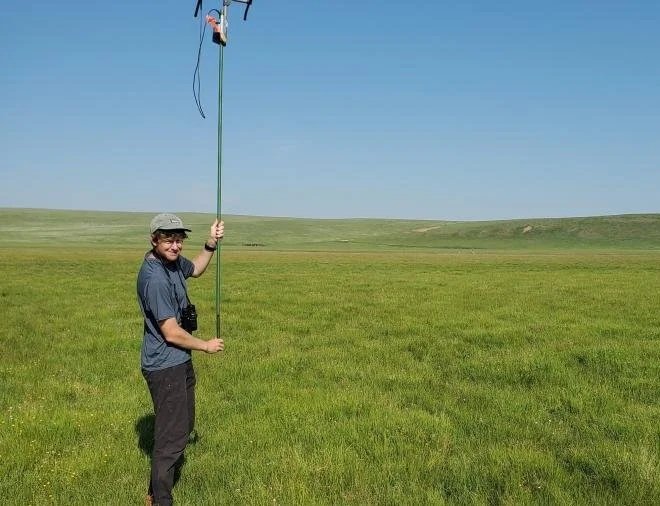
Paul is a research associate at the Swiss Ornithological Institute in Sempach, Switzerland. Read more about his research and interests in the interview below.
Paul’s website:
https://pauldufour80.wordpress.com/
Bluesky: @pauldufour80.bsky.social
Photo at left: Paul Dufour in Mongolia, searching with a VHF antenna for Richard's Pipits that were equipped with light-level geolocators the previous year
What’s your main research focus at the moment?
My research interests focus on bird migration at the intersection of evolutionary biology and ecology. I am broadly interested in various aspects of seasonal migration, the evolution of this behavior, and how such movements can influence eco-evolutionary processes. By studying lost individuals (vagrants) from Siberia, I seek, on the one hand, to understand how new migratory routes can emerge in nature, and on the other hand, to use these abnormal movements to gain deeper insights into navigation mechanisms.
Can you describe your research career? Where, what, when?
I am French. I grew up in northern France, then completed part of my studies in Montpellier, before moving to Grenoble in the Alps for my PhD. During my PhD, I had the opportunity to use several approaches (biogeography, species distribution modeling, phylogenetics, tracking) applied on different model systems (macro and micro) to study various aspects of the evolution of bird migration. It was also during my PhD that I began projects on vagrancy and changes in orientation in Siberian passerines. I then moved at the University of Gothenburg in Sweden, where I continued my work on macroevolution, before returning to Montpellier to study various aspects of migration strategies in songbirds using multi-sensor tracking. Early 2025, I joined the Swiss Ornithological Institute as a research associate in the migration unit.
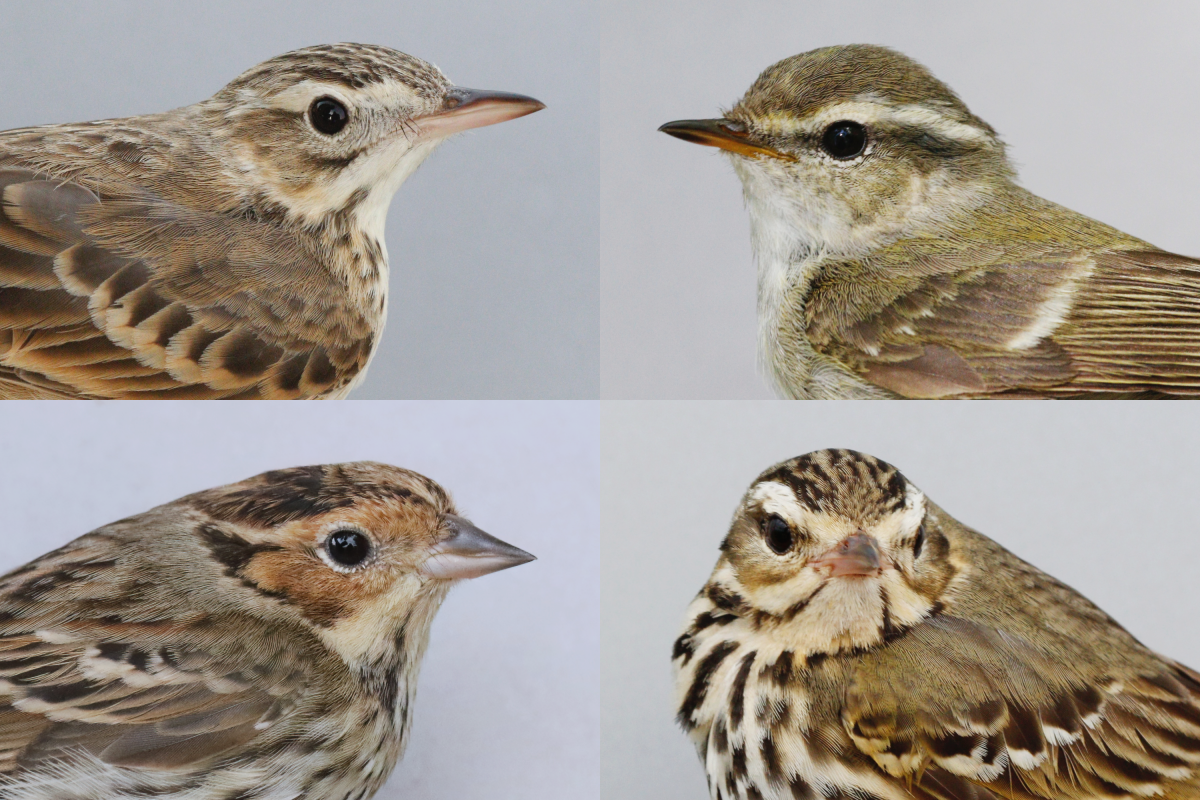
Four songbird species of Siberian origins (Richard’s pipit, yellow-browed warbler, little bunting and olive-backed pipit) for which Paul is studying the evolution of their occurrences in Europe in connection with possible changes in their migratory orientations
How did you come to be a scientist with an interest in birds?
I’ve always been passionate about nature (starting with dinosaurs!) and I began trying to identify every bird I saw after receiving my first Collins Bird Guide (Delachaux in France) around the age of eight. My interest in research developed quite naturally as I discovered new places and new bird species, accompanied with more questions about their distribution, colors and movements. Many of my research questions stem from field experiences and/or conversations with birders and friends, and I feel extremely fortunate to be able to combine work and passion in trying to answer these questions.
Enough about work: what do you do when you’re not working?
I enjoy spending time in nature and also do quite a bit of sport (mainly running and cycling) but birds are never far away. I spend a lot of my free time birding and traveling to discover new habitats or see species I have long dreamed about. I especially enjoyed growing my green list by bike from my home in Montpellier, which led to some great adventures in the Pyrenees and the Alps.
Journal of Avian Biology—who are we?
JOURNAL of AVIAN BIOLOGY: Empirical and Theoretical Research in Ornithology is an Open Access journal owned by the Nordic Society Oikos.
We are a journal for innovative, hypothesis-driven research on the biology of birds, with a particular emphasis on ecological, evolutionary and behavioural studies. We welcome submissions that study avian biology across all levels of ecological organization, from organisms and populations to communities and ecosystems. The journal also welcomes studies that report negative results, provided they are conducted rigorously and are scientifically informative. As a Nordic Society Oikos journal, we advocate research that is fair, openly accessible and reproducible.
Thinking about publishing with us?
Journal of Avian Biology offers a Review Award for early-career researchers.
We value ethical standards in science (EDI, Open Access, waivers, accessible data and code, CRediT)
Check out JAB’s journal metrics and see our Author Guidelines
Our journals, our society—join us!
The Nordic Society Oikos engages the global scientific community through five international journals…

…and supports the national ecological societies of the five Nordic countries. Anyone worldwide can join the Nordic Society Oikos.
NSO is a home for ecologists, a nexus for knowledge, and a guiding light for ecology worldwide. We are an active network of ecologists in the Nordic region and around the globe.
Why join NSO? Membership benefits include:
Connections across a global community of ecologists and five national societies
NSO newsletters with member-only updates about Nordic ecology and society activities
Ongoing opportunities for promotion on NSO’s digital platforms and social media channels
Discounted registration for NSO’s biennial conference
Eligibility to apply for NSO Grants
Each member receives additional benefits from one of our five national societies:
Danish Oikos Society
Oikos Finland
Icelandic Ecological Society
Norwegian Ecological Society
Swedish Oikos Society
When you join NSO, you also become a member of one of our national societies. Which one? That’s up to you! Each national society provides its own benefits, including discounts to national conferences. Learn more about us at nordicsocietyoikos.org.