
Journal Update | Journal of Avian Biology launches a new article type
Methods and Tools: a new article type and a Virtual Issue
We are pleased to announce the launch of a new article type in the Journal of Avian Biology: Methods and Tools. Until now, new methods in avian biology have typically been published as Research Articles or Short Communications. The new article type will provide a dedicated venue for analytical tools, software, experimental designs, and field and laboratory techniques, giving these contributions greater visibility within the journal. From this point forward, Research Articles and Short Communications will place an even stronger emphasis on hypothesis-driven research.
Methods and Tools articles need to present novel or substantially improved methodological approaches that advance research in avian biology. Contributions should go beyond incremental methodological refinements, demonstrating broad applicability and clear potential to shape future research across systems, questions, or disciplines in avian biology, and may include robust validation or impact studies of widely used methods or tools. You can find some examples of Research Articles that would now fit into this article type here and here.
Methods and Tools: expanding the avian research toolkit
To help launch our new article type, we have put together a Virtual Issue of method-focused Research Articles or Short Communications that have been published in the journal during the last three years. All of the articles in ‘Methods and Tools: A Virtual Issue‘ are open access. You can find a short synthesis of the Virtual Issue below.
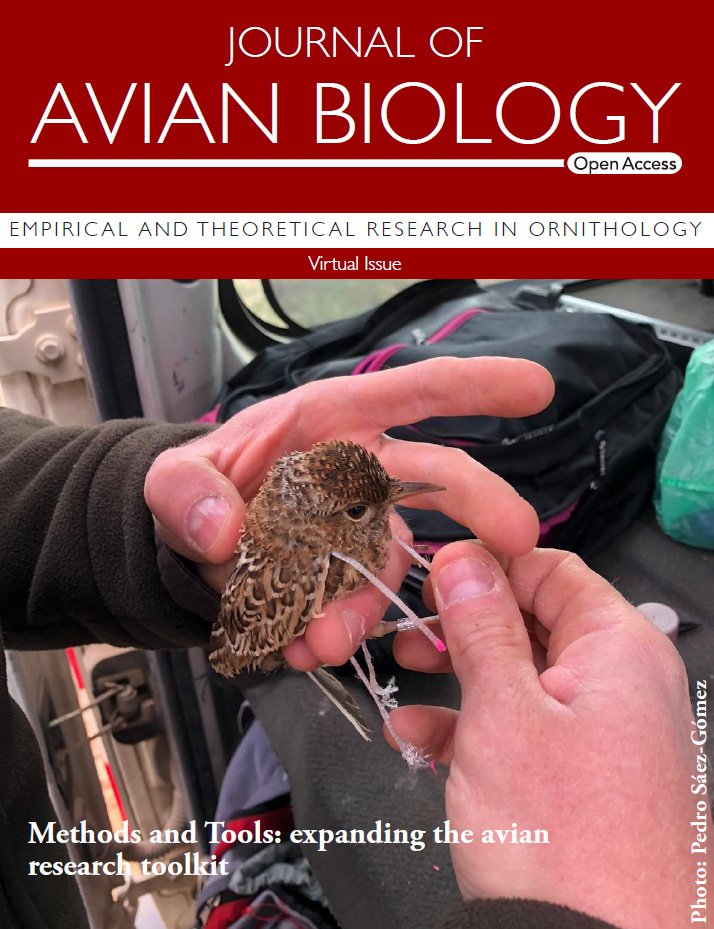
Photo of a Dupont's lark being fitted with a GPS/VHF tag and a novel soluble backpack harness. Photo: Pedro Sáez-Gómez.
Research advances in avian ecology, evolution and behaviour often also depend on the development, evaluation and refinement of methods. From tracking technologies and analytical approaches to novel molecular and imaging techniques, methodological innovation underpins our ability to ask new questions and to revisit long-standing ones with greater precision.
This virtual issue brings together a selection of papers that exemplify the breadth and importance of methodological work in avian research. The contributions span diverse domains, including the evaluation of tracking technologies and their impacts, improvements in population estimation and monitoring, the extraction of behavioural and reproductive parameters from high-resolution data, and the development and comparison of laboratory and computational approaches. We hope this collection will serve as both a resource and an inspiration for researchers developing, applying and refining tools to better understand bird biology.
Journal of Avian Biology—who are we?

JOURNAL of AVIAN BIOLOGY: Empirical and Theoretical Research in Ornithology is an Open Access journal owned by the Nordic Society Oikos.
We are a journal for innovative, hypothesis-driven research on the biology of birds, with a particular emphasis on ecological, evolutionary and behavioural studies. We welcome submissions that study avian biology across all levels of ecological organization, from organisms and populations to communities and ecosystems. The journal also welcomes studies that report negative results, provided they are conducted rigorously and are scientifically informative. As a Nordic Society Oikos journal, we advocate research that is fair, openly accessible and reproducible.
Thinking about publishing with us?
Journal of Avian Biology offers a Review Award for early-career researchers.
We value ethical standards in science (EDI, Open Access, waivers, accessible data and code, CRediT)
Check out JAB’s journal metrics and see our Author Guidelines
Our journals, our society—join us!
The Nordic Society Oikos engages the global scientific community through five international journals…

…and supports the national ecological societies of the five Nordic countries. Anyone worldwide can join the Nordic Society Oikos.
NSO is a home for ecologists, a nexus for knowledge, and a guiding light for ecology worldwide. We are an active network of ecologists in the Nordic region and around the globe.
Why join NSO? Membership benefits include:
Connections across a global community of ecologists and five national societies
NSO newsletters with member-only updates about Nordic ecology and society activities
Ongoing opportunities for promotion on NSO’s digital platforms and social media channels
Discounted registration for NSO’s biennial conference
Eligibility to apply for NSO Grants
Each member receives additional benefits from one of our five national societies:
Danish Oikos Society
Oikos Finland
Icelandic Ecological Society
Norwegian Ecological Society
Swedish Oikos Society
When you join NSO, you also become a member of one of our national societies. Which one? That’s up to you! Each national society provides its own benefits, including discounts to national conferences. Learn more about us at nordicsocietyoikos.org.