
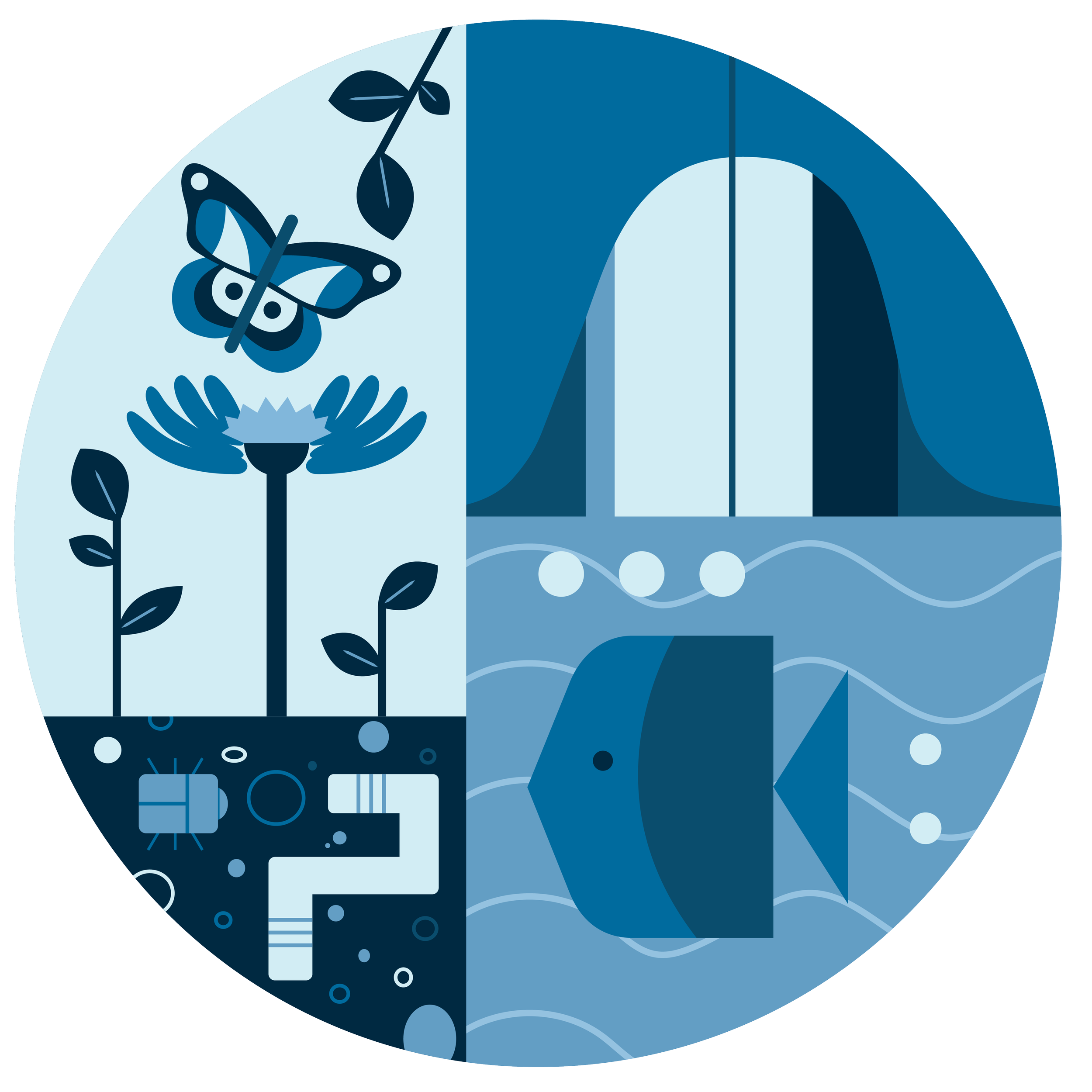
Cover | How Islets Save Arctic Bird Nests
October Cover
Photo by Louis-Pierre Ouellet
Download the high-resolution image
Read the Open Acess paper in Oikos, by Beaudoin et al. (2026): Experimental and field evidence indicate that islet-nesting tundra birds experience reduced nest predation and benefit indirectly from high snow goose densities
Abstract:
Landscape features can shape the occurrence and strength of predator–prey interactions by influencing predation risk and prey distribution. In the High Arctic, some bird species select nesting sites with physical features that impede access for their main terrestrial predator, the Arctic fox.
We investigated how nest microhabitat characteristics and prey availability modulate nest survival in tundra birds that select pond and lake islets as breeding sites. Over four summers, we analyzed survival of 132 cackling goose and 55 glaucous gull nests located on islets or pond and lake shores within a 150-km2 area encompassing a snow goose colony on Bylot Island, Nunavut, Canada. Over three years, we also assessed the effect of microhabitat on predation risk using artificial nests. We found that islets act as partial prey refuges, with higher nest survival on islets than on pond and lake shores.
Nest survival generally increased with islet distance from shore, but we found little evidence of this effect for cackling geese and glaucous gulls, which rarely nested on islets near shore. Moreover, water depth surrounding islets had little to no influence on any nest type. Nest survival on islets was much lower in a year with relatively low snow goose nest density, suggesting that geese may confer a short-term positive indirect effect on other bird species nesting on islets within or near the main goose nesting area. Since the Arctic fox was virtually the sole predator of artificial nests, our findings suggest that annual variation in nest survival on islets was driven by a shift in fox foraging behavior in response to changes in prey availability across the landscape.
Our study, which integrates multi-year monitoring and field experiments, highlights the interplay between microhabitat selection and predator–multi-prey dynamics in the Arctic tundra.
You can check the photographer’s IG page at @lpo.photographie.
Oikos—who are we?

OIKOS: Advancing Ecology is a leading and longstanding journal in ecology, owned by the Nordic Society Oikos.
We publish innovative empirical and theoretical research that spans across diverse taxa, systems, and disciplines. With a focus on advancing our understanding of ecological mechanisms, processes, and patterns, Oikos fosters debate and speculation, encouraging innovative and provocative ideas that shape ecological thinking. Alongside standard Research papers and Meta-Analyses, we have unique categories of Forum, Ignite, and Dialogue papers.
Thinking about publishing with us?
Oikos offers optional sections for speculations and alternative viewpoints.
We value ethical standards in science (EDI, accessible data and code, CRediT)
Check out Oikos’s journal metrics and see our Author Guidelines
Our journals, our society—join us!
The Nordic Society Oikos engages the global scientific community through five international journals…
…and supports the national ecological societies of the five Nordic countries. Anyone worldwide can join the Nordic Society Oikos.
NSO is a home for ecologists, a nexus for knowledge, and a guiding light for ecology worldwide. We are an active network of ecologists in the Nordic region and around the globe.
Why join NSO? Membership benefits include:
Connections across a global community of ecologists and five national societies
NSO newsletters with member-only updates about Nordic ecology and society activities
Ongoing opportunities for promotion on NSO’s digital platforms and social media channels
Discounted registration for NSO’s biennial conference
Eligibility to apply for NSO Grants
Each member receives additional benefits from one of our five national societies:
Danish Oikos Society
Oikos Finland
Icelandic Ecological Society
Norwegian Ecological Society
Swedish Oikos Society
When you join NSO, you also become a member of one of our national societies. Which one? That’s up to you! Each national society provides its own benefits, including discounts to national conferences. Learn more about us at nordicsocietyoikos.org.