
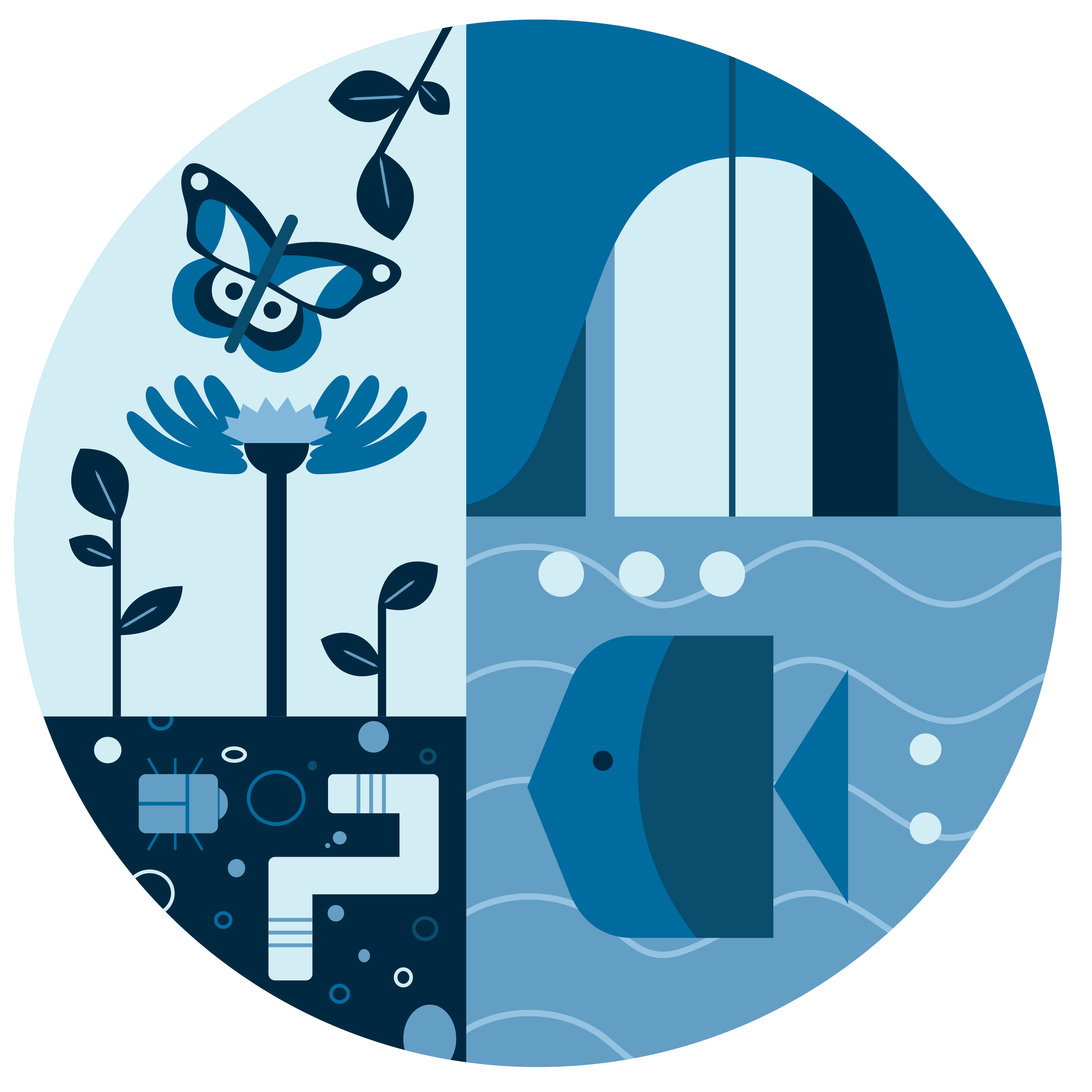
Cover | First Come, First Served on Hawaiʻi’s Coral
May Cover
Photo by Erik Brush
Download the high-resolution image
On Hawaiian reefs, a field experiment shows that early-arriving competitors and predators can strongly shape who gets to live on coral colonies, with their presence limiting the diversity and abundance of later colonizers and potentially reducing beneficial species that support coral health.
Read the open access paper in Oikos by Brush et al. (2026): Habitat characteristics and priority effects shape fish and invertebrate assemblages inhabiting the coral Pocillopora grandis in Hawaiʻi
Abstract:
The structure of ecological communities is driven by an interplay of abiotic and biotic factors, yet the history of this interplay is less often considered. Priority effects, or how prior residents affect later-arriving individuals, can strongly affect local assemblage trajectory, potentially leading to indirect effects on ecosystem state or function.
On Hawaiian reefs, pocilloporid corals provide the primary source of branching habitat for fishes and invertebrates, with Pocillopora grandis, the largest species, often hosting substantial, multispecies assemblages. Smaller P. grandis colonies support assemblages dominated by an interference competitor, the blue-eye damselfish Plectroglyphidodon johnstonianus, and/or a mesopredator, the arc-eye hawkfish Paracirrhites arcatus, as well as mutualistic guard crabs of the genus Trapezia.
Visual surveys showed that the assemblage size and abundance of other resident species, particularly the competitively inferior damselfish Dascyllus albisella and some guard crab species, increased greatly with colony size. During a six-month press removal of P. johnstonianus and P. arcatus on small P. grandis colonies off the south shore of Oʻahu, Hawaiʻi, we tracked the colonization of fishes and invertebrates every two weeks in the presence and absence of these two strong interactors.
By the end of the experiment, colonizing fish and invertebrate abundance were approximately 7- and 4-fold greater in the absence of the competitor and the predator, respectively. Likewise, fish and invertebrate species richness was approximately 6- and 1.7-fold greater, respectively. The damselfish D. albisella, of a genus known to benefit corals, was almost entirely prohibited by the strong interactors from colonizing these corals. However, trapezid guard crabs, while not directly manipulated during the experiment, were minimally affected.
These results indicate that at smaller colony sizes, assemblages of fishes and invertebrates inhabiting P. grandis in Hawaiʻi are likely inhibited by priority effects, potentially reducing mutualist interactions and affecting the host colony and local ecosystem function.
Oikos—who are we?

OIKOS: Advancing Ecology is a leading and longstanding journal in ecology, owned by the Nordic Society Oikos.
We publish innovative empirical and theoretical research that spans across diverse taxa, systems, and disciplines. With a focus on advancing our understanding of ecological mechanisms, processes, and patterns, Oikos fosters debate and speculation, encouraging innovative and provocative ideas that shape ecological thinking. Alongside standard Research papers and Meta-Analyses, we have unique categories of Forum, Ignite, and Dialogue papers.
Thinking about publishing with us?
Oikos offers optional sections for speculations and alternative viewpoints.
We value ethical standards in science (EDI, accessible data and code, CRediT)
Check out Oikos’s journal metrics and see our Author Guidelines
Our journals, our society—join us!
The Nordic Society Oikos engages the global scientific community through five international journals…
…and supports the national ecological societies of the five Nordic countries. Anyone worldwide can join the Nordic Society Oikos.
NSO is a home for ecologists, a nexus for knowledge, and a guiding light for ecology worldwide. We are an active network of ecologists in the Nordic region and around the globe.
Why join NSO? Membership benefits include:
Connections across a global community of ecologists and five national societies
NSO newsletters with member-only updates about Nordic ecology and society activities
Ongoing opportunities for promotion on NSO’s digital platforms and social media channels
Discounted registration for NSO’s biennial conference
Eligibility to apply for NSO Grants
Each member receives additional benefits from one of our five national societies:
Danish Oikos Society
Oikos Finland
Icelandic Ecological Society
Norwegian Ecological Society
Swedish Oikos Society
When you join NSO, you also become a member of one of our national societies. Which one? That’s up to you! Each national society provides its own benefits, including discounts to national conferences. Learn more about us at nordicsocietyoikos.org.