
Study | Variation in physiological indicators among forest birds
Investigating natural variation in physiological indicators across a forest bird community
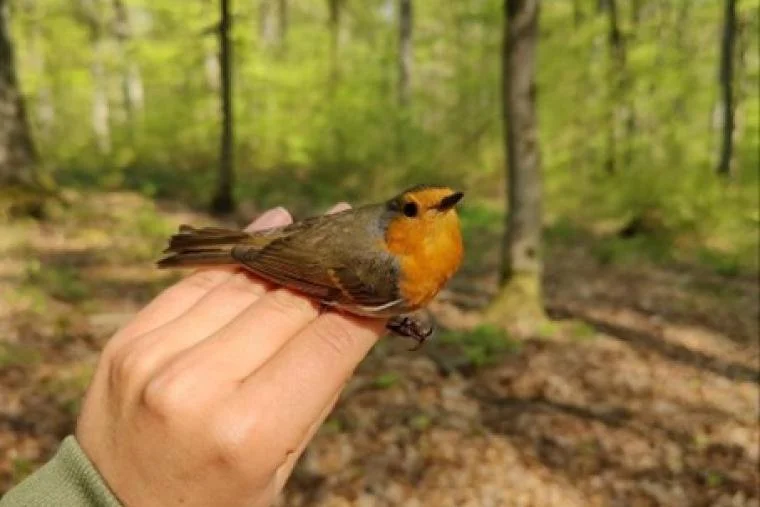
The European robin (Erithacus rubecula) was the most frequently captured species in our forest community (Photo: Finja Strehmann)
Text by Finja Strehmann
Birds face a wide range of challenges throughout their lives—some imposed by the environment, others shaped by intrinsic factors such as age, sex, and breeding status. Their ability to physiologically adapt to these challenges determines not only their individual survival but also their reproductive success.
Studying these physiological responses can provide valuable insights into early warning indicators of population health, ultimately contributing to conservation efforts. However, before we can assess the impact of environmental factors on bird communities, it is crucial to first understand natural variation in physiological indicators.
A community-wide perspective on physiological indicators
In their recently published study, Finja Strehmann and colleagues examined the natural variation in the heterophil-to-lymphocyte (H/L) ratio—a well-established physiological indicator of immune function, overall health, and long-term physiological adaptation—across a bird community inhabiting a managed mixed forest in Germany. Building on previous research that has often focused on single species, their study examined multiple species within a community, incorporating their evolutionary relatedness through a phylogenetically controlled approach.
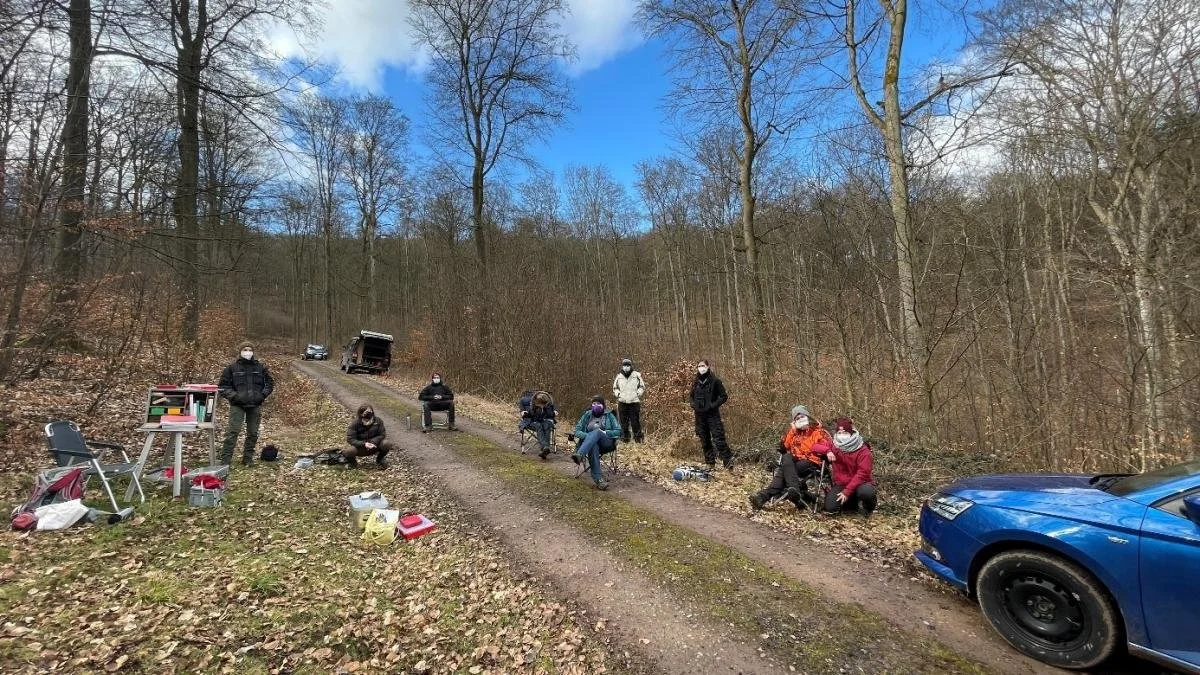
Team of researchers and student assistants during field work in the early breeding season (Photo: Sascha Rösner)
Over four years, from March until August, with a dedicated team of researchers and student assistants, they collected blood samples from 409 individuals spanning 22 species at ten mist-netting sites across the forest ecosystem. The study design included both standard mist nets and high nets to sample individuals at different canopy levels, enhancing the diversity of captured species. No baits or lures were used to reduce confounding influences on the variation of the H/L ratio.
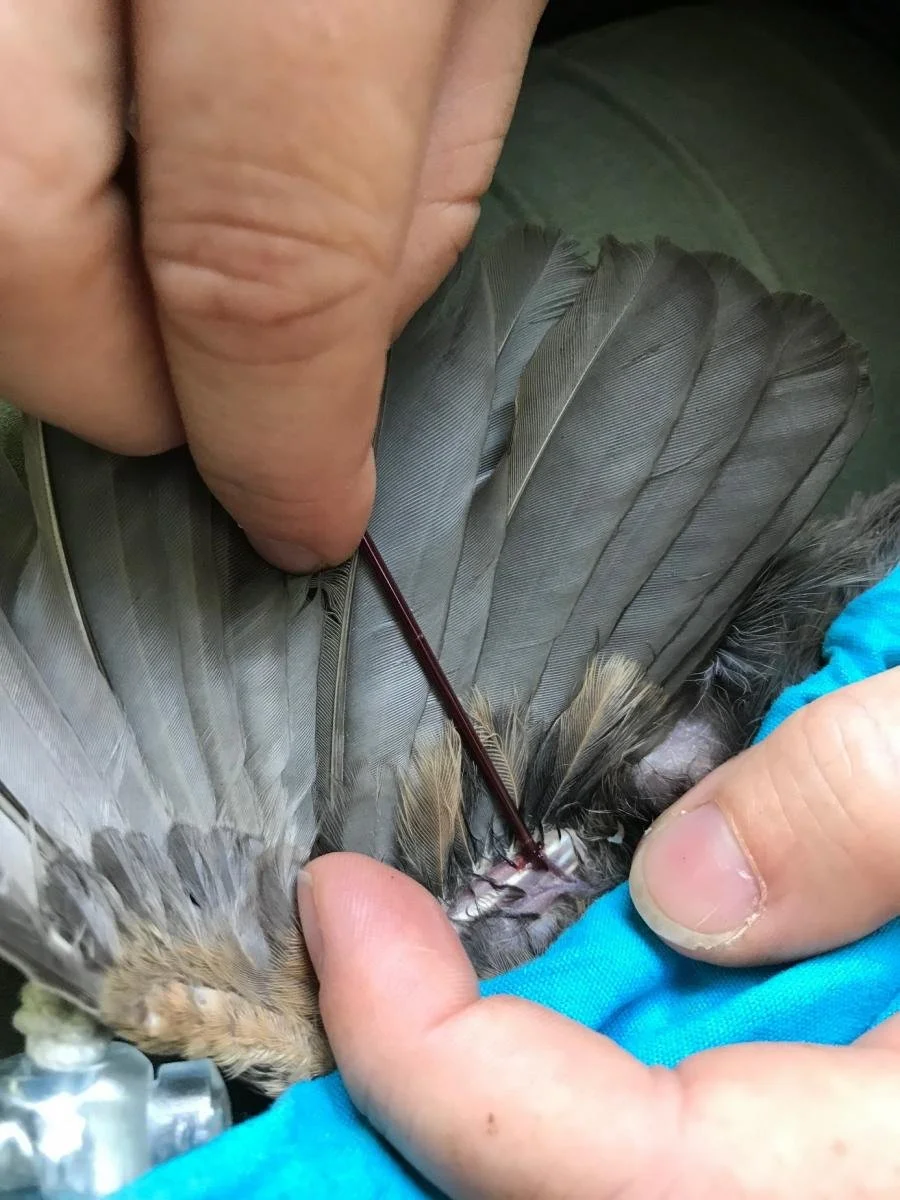
Taking a blood sample of a blackbird (Turdus merula) by puncturing the wing vein (Photo: Finja Strehmann)
Leveraging deep learning for automated blood cell analysis
One of the significant advancements in the study by Strehmann et al. was the use of a deep learning approach to automate the identification and quantification of blood cells. By developing a convolutional neural network (CNN), they streamlined the process of analyzing blood smears, reducing human error and making large-scale physiological assessments more feasible. This novel method significantly enhanced the efficiency and accuracy of H/L ratio calculations, opening the door for broader applications in ecological and conservation physiology.
Key findings: natural variation in physiological indicators
The study revealed that intrinsic factors such as age, sex, and breeding status influence H/L ratios across the bird community. Adult birds exhibited higher ratios than juveniles, while females showed slightly elevated values compared to males, particularly during the breeding season. Incubating birds also tended to have higher H/L ratios. Additionally, a significant phylogenetic signal was observed, highlighting the importance of considering evolutionary relationships when interpreting physiological indicators. These findings provide a foundation for further research exploring environmental influences such as habitat disturbance, climate change, and parasite infestations on bird health.
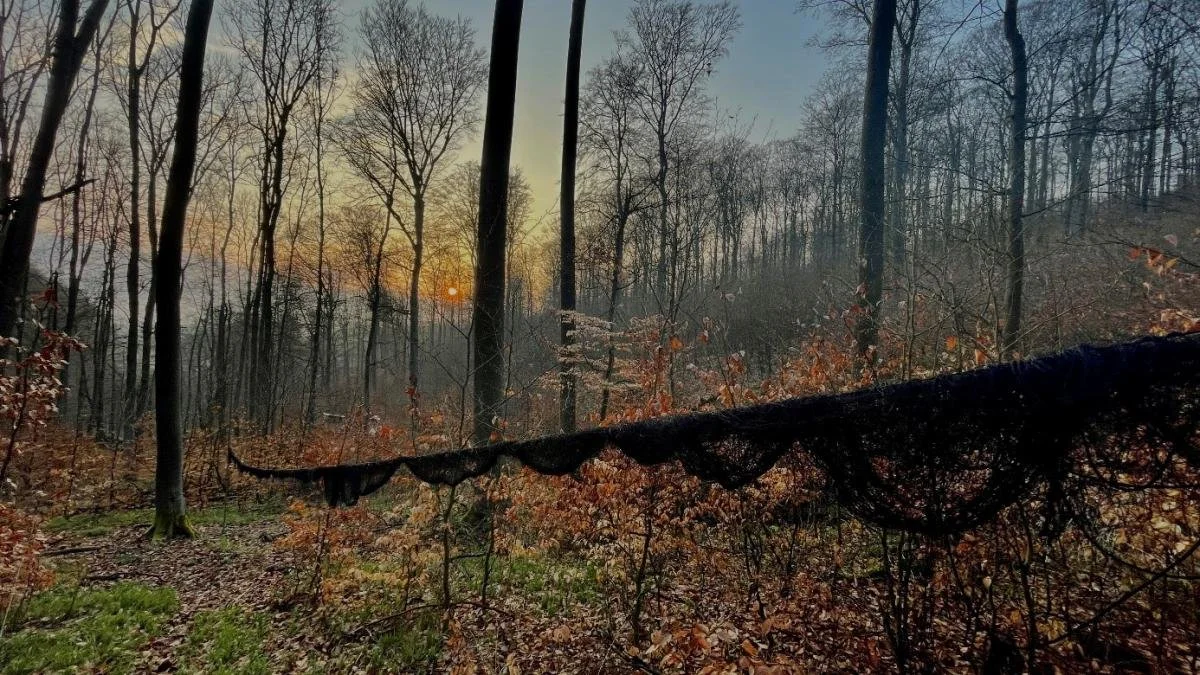
Early morning at one of the mist netting locations just before opening the nets for capture routine in the forest (Photo: Finja Strehmann)
Journal of Avian Biology—who are we?
JOURNAL of AVIAN BIOLOGY: Empirical and Theoretical Research in Ornithology is an Open Access journal owned by the Nordic Society Oikos.
We are a journal for innovative, hypothesis-driven research on the biology of birds, with a particular emphasis on ecological, evolutionary and behavioural studies. We welcome submissions that study avian biology across all levels of ecological organization, from organisms and populations to communities and ecosystems. The journal also welcomes studies that report negative results, provided they are conducted rigorously and are scientifically informative. As a Nordic Society Oikos journal, we advocate research that is fair, openly accessible and reproducible.
Thinking about publishing with us?
Journal of Avian Biology offers a Review Award for early-career researchers.
We value ethical standards in science (EDI, Open Access, waivers, accessible data and code, CRediT)
Check out JAB’s journal metrics and see our Author Guidelines
Our journals, our society—join us!
The Nordic Society Oikos engages the global scientific community through five international journals…

…and supports the national ecological societies of the five Nordic countries. Anyone worldwide can join the Nordic Society Oikos.
NSO is a home for ecologists, a nexus for knowledge, and a guiding light for ecology worldwide. We are an active network of ecologists in the Nordic region and around the globe.
Why join NSO? Membership benefits include:
Connections across a global community of ecologists and five national societies
NSO newsletters with member-only updates about Nordic ecology and society activities
Ongoing opportunities for promotion on NSO’s digital platforms and social media channels
Discounted registration for NSO’s biennial conference
Eligibility to apply for NSO Grants
Each member receives additional benefits from one of our five national societies:
Danish Oikos Society
Oikos Finland
Icelandic Ecological Society
Norwegian Ecological Society
Swedish Oikos Society
When you join NSO, you also become a member of one of our national societies. Which one? That’s up to you! Each national society provides its own benefits, including discounts to national conferences. Learn more about us at nordicsocietyoikos.org.