
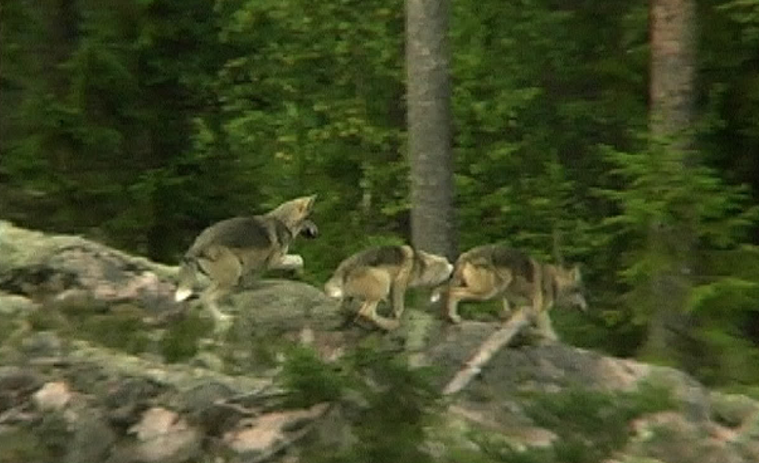
Wolf pups photographed in August 2004 in the Jangen territory, where white tail tips were first observed among Scandinavian wolves. Photo: Arne Mortensen.
The introduction of anomalous coat color in Scandinavian wolves
Anomalous coat color draws considerable attention, especially in wild populations which are expected to be under strong natural selection and therefore exhibit limited phenotypic variation. For example, a well-known characteristic for red foxes (Vulpes vulpes) is their white tail tip.
Similarly, the black tail tip is an equally characteristic trait for grey wolves (Canis lupus). In the small, isolated and highly inbred Scandi-navian wolf population, however, some wolves have a white tail tip.
What went wrong here? Do Scandinavian wolves carry a chunk of red fox DNA?
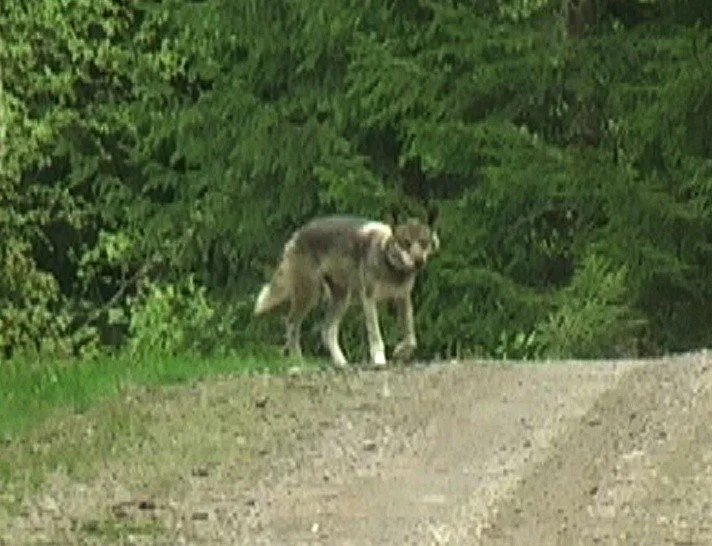
The breeding female photographed in May 2006 in the Jangen territory. Photo: Arne Mortensen
Indeed, the observation of this anomalous trait raised several questions particularly relevant in the context of small, highly inbred populations: how is the trait genetically inherited, has its expression been facilitated by the high level of inbreeding, and can its origin be traced directly to one of the few founders of the population?
In our recent study published in Wildlife Biology, we examined the occurrence of this trait in the Scandinavian wolf population by combining genetic and phenotypic informa-tion with a near complete pedigree of almost all Scandinavian wolves. We managed to identify the likely genetic variant causing this anomaly, a haplotype linked to the MITF gene, comprising both the gene itself and likely regulatory elements. MITF plays a key role in the production of pigment producing cells, and the identified genetic variant likely disrupts this process, resulting in unpig-mented areas of the fur.
This haplotype was found in all genotyped offspring of the third founder, an immigrant from the neighboring wolf population in Finland and Russia. He reproduced for the first time in 1991 and genetically rescued the Scandinavian wolf population by introducing new genetic material, including this variant associated with fur color anomaly. Our analyses show that the genetic variant is recessive, making inbreeding an important driver for the expression of this trait through the inheritance of identical copies derived from a common ancestor.
In a rapidly changing environment, many wild populations face reduced population size, lack of gene flow and increased risk of inbreeding. Indeed, the maintenance of genetic variation is essential for long-term population viability. Our findings demonstrate the importance of immigration and introduction of new genetic material in small, isolated and highly inbred populations, but also how such vital immigration can bring about unforeseen side effects.
Wildlife Biology—who are we?
WILDLIFE BIOLOGY: Journal for Wildlife Research, Management, and Conservation is an Open Access journal owned by the Nordic Society Oikos.
Our journal promotes a scientific basis for the conservation and management of wildlife and human-wildlife relationships. We adopt a broad concept of wildlife management to safeguard sustainable relationships between wildlife and other human interests. This includes all policies and actions with the purpose of conservation, sustainable use, or control of wildlife and its habitats. We welcome theoretical, empirical, and practical articles from all areas of wildlife science.
Thinking about publishing with us?
Wildlife Biology publishes research, review, and management Articles as well as short Communications.
We value ethical standards in science (EDI, Open Access, waivers, accessible data and code, CRediT)
Check out Wildlife Biology’s journal metrics and see our Author Guidelines
Our journals, our society—join us!
The Nordic Society Oikos engages the global scientific community through five international journals…
…and supports the national ecological societies of the five Nordic countries. Anyone worldwide can join the Nordic Society Oikos.
NSO is a home for ecologists, a nexus for knowledge, and a guiding light for ecology worldwide. We are an active network of ecologists in the Nordic region and around the globe.
Why join NSO? Membership benefits include:
Connections across a global community of ecologists and five national societies
NSO newsletters with member-only updates about Nordic ecology and society activities
Ongoing opportunities for promotion on NSO’s digital platforms and social media channels
Discounted registration for NSO’s biennial conference
Eligibility to apply for NSO Grants
Each member receives additional benefits from one of our five national societies:
Danish Oikos Society
Oikos Finland
Icelandic Ecological Society
Norwegian Ecological Society
Swedish Oikos Society
When you join NSO, you also become a member of one of our national societies. Which one? That’s up to you! Each national society provides its own benefits, including discounts to national conferences. Learn more about us at nordicsocietyoikos.org.