
New Editor | Diego Santiago Alarcon, subject editor for JAB
Warmly welcome to the editorial board of Journal of Avian Biology - Diego Santiago Alarcon!
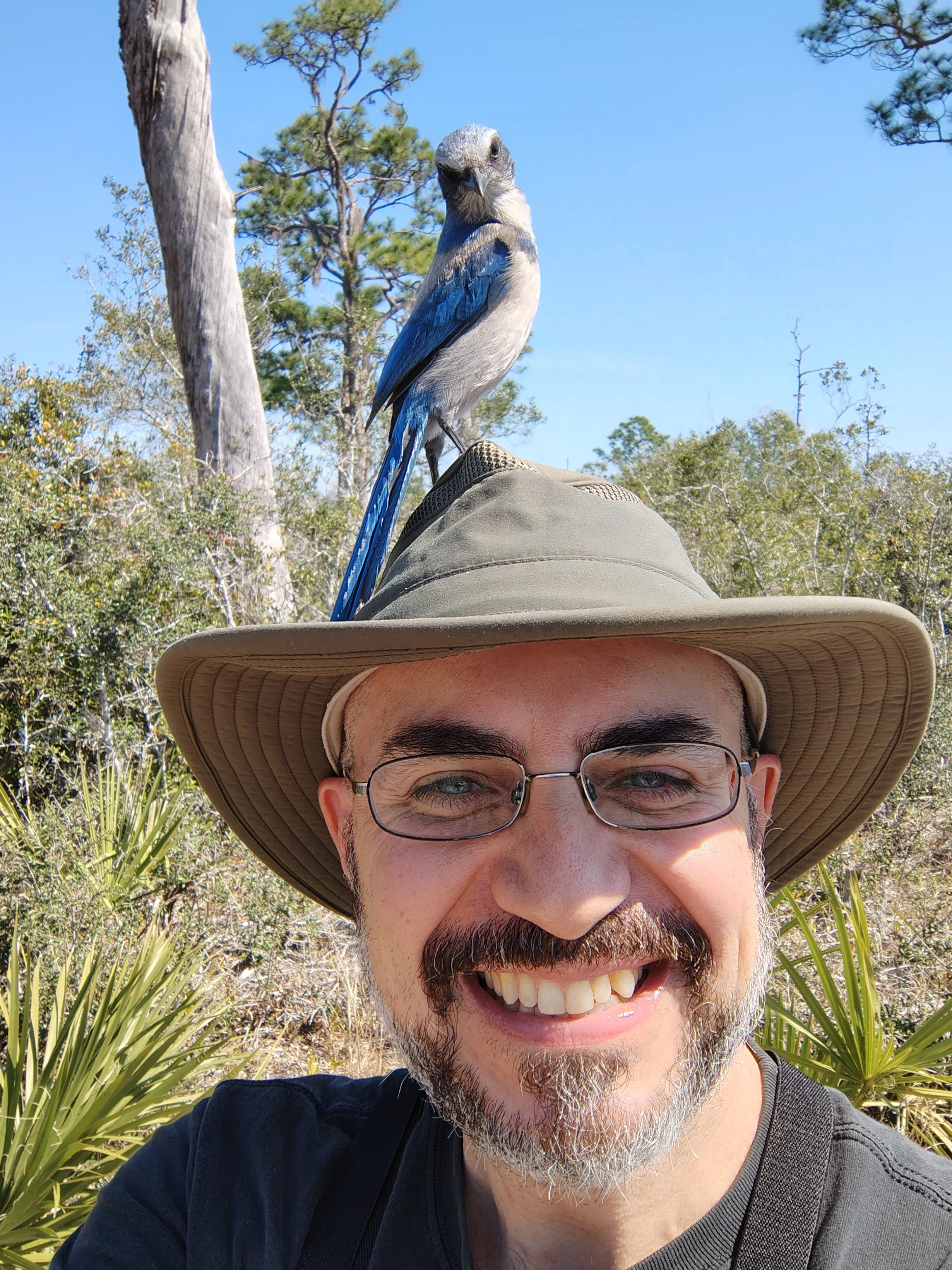
Diego Santiago Alarcon is a disease and community ecologist studying how human influences shape bird-parasite interactions. He is based at the Department of Integrative Biology, University of South Florida, USA.
Read the short interview with Diego below and learn more about his research and his interests.
What's your main research focus at the moment?
Most of my lab's work asks how human-modified landscapes change the relationship between birds, their blood parasites, and the insects that carry those parasites. We work along urban-to-rural gradients (for a decade in the cloud forests and cities of Veracruz, Mexico, and now in the Tampa region of Florida) combining field sampling, vector blood-meal analysis, and bird hematology to find where infection risk actually concentrates and what it costs the host. I am also part of an international effort to bring together avian blood-smear records from across the world, so that we can ask these questions at a continental scale instead of one study site at a time. In parallel, I run a more speculative line, asking whether quantum processes contribute to how mutations arise under environmental stress. A very different question, but the same instinct: look where the standard explanation feels incomplete.
Can you describe your research career? Where, what, when?
I started in Tabasco, in southeastern Mexico (Gulf Coast), where my undergraduate thesis was on bird communities in the flooded forests of the Centla Wetlands Biosphere Reserve. A Fulbright fellowship then took me to the University of Missouri-St. Louis, where I stayed from 2001 to 2008 for both a master's and a PhD with Patricia Parker and Robert E. Ricklefs, first on the population genetics of the endemic Galápagos dove, then on the evolutionary ecology of the haemosporidian parasites infecting New World doves. From there an Alexander von Humboldt fellowship took me to the University of Freiburg (2009-2011), where I worked on parasite diversification and host-vector networks across a migratory divide in southern Germany. In 2011 I returned to Mexico as a researcher at INECOL in Xalapa, Veracruz, where I spent ten years and where my urban disease ecology really began. Since 2021 I have been at the Department of Integrative Biology, University of South Florida.
How come that you became a scientist with an interest in birds?
Birds were not the plan; I am curious about many things. As an undergraduate in Tabasco, I was simply hungry for research of any kind, I spent two summers in Mexico's national summer research program, and one of my first projects was on molecular evolution in primates. What settled it was fieldwork after trying many animal groups. My honors thesis put me in the flooded Haematoxylon forests of the Centla wetlands, counting birds at dawn, and I discovered I could happily do that. Birds turned out to be an almost unfair study system for someone who likes the field, the laboratory, and has an interdisciplinary edge: abundant, diverse, easy to observe, carrying a whole parasite fauna inside them, and an amazing model for interdisciplinary ideas (e.g., engineering designs). The parasites came a little later, and I have never really left them since.
Enough about work: what do you do when you're not working?
Family, mostly. My wife Ana is building a plant nursery, so much of our time goes to plants, long walks, and following our small son Tobias toward whatever he has decided to investigate that week. Our parish life in Tampa matters a great deal to us, and I will say plainly that my faith is not something I leave at the door of the lab; the conviction that the world is intelligible, and worth understanding truly, is precisely what keeps me pushing at it. Beyond that I read and write well outside my own field, and I have been building a program on how to think and create across disciplines, which is really just my excuse to keep doing that.
Journal of Avian Biology—who are we?
JOURNAL of AVIAN BIOLOGY: Empirical and Theoretical Research in Ornithology is an Open Access journal owned by the Nordic Society Oikos.
We are a journal for innovative, hypothesis-driven research on the biology of birds, with a particular emphasis on ecological, evolutionary and behavioural studies. We welcome submissions that study avian biology across all levels of ecological organization, from organisms and populations to communities and ecosystems. The journal also welcomes studies that report negative results, provided they are conducted rigorously and are scientifically informative. As a Nordic Society Oikos journal, we advocate research that is fair, openly accessible and reproducible.
Thinking about publishing with us?
Journal of Avian Biology offers a Review Award for early-career researchers.
We value ethical standards in science (EDI, Open Access, waivers, accessible data and code, CRediT)
Check out JAB’s journal metrics and see our Author Guidelines
Our journals, our society—join us!
The Nordic Society Oikos engages the global scientific community through five international journals…

…and supports the national ecological societies of the five Nordic countries. Anyone worldwide can join the Nordic Society Oikos.
NSO is a home for ecologists, a nexus for knowledge, and a guiding light for ecology worldwide. We are an active network of ecologists in the Nordic region and around the globe.
Why join NSO? Membership benefits include:
Connections across a global community of ecologists and five national societies
NSO newsletters with member-only updates about Nordic ecology and society activities
Ongoing opportunities for promotion on NSO’s digital platforms and social media channels
Discounted registration for NSO’s biennial conference
Eligibility to apply for NSO Grants
Each member receives additional benefits from one of our five national societies:
Danish Oikos Society
Oikos Finland
Icelandic Ecological Society
Norwegian Ecological Society
Swedish Oikos Society
When you join NSO, you also become a member of one of our national societies. Which one? That’s up to you! Each national society provides its own benefits, including discounts to national conferences. Learn more about us at nordicsocietyoikos.org.