
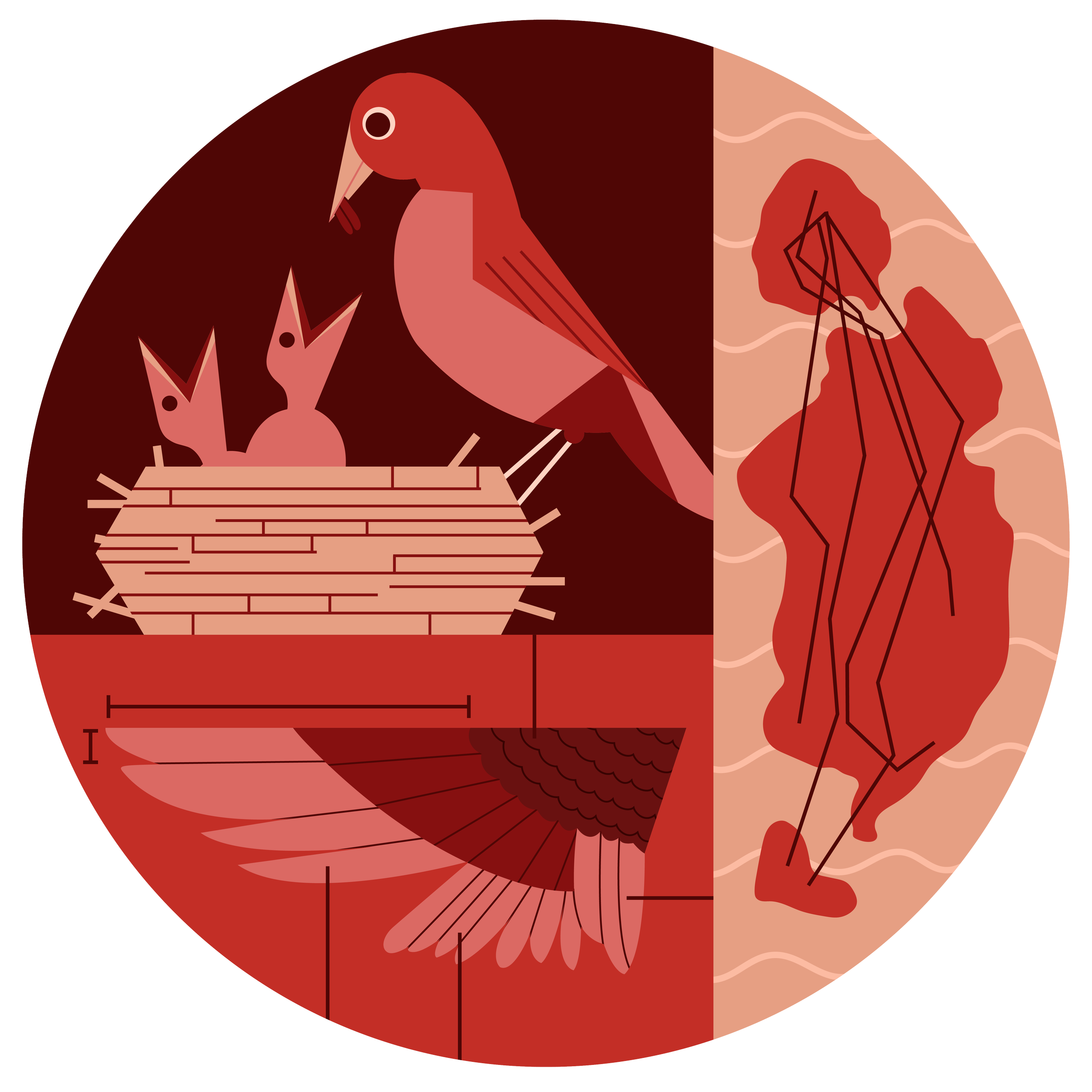
Cover | Do warm roads help nightjars fuel for migration?
Photo of a red-necked nightjar. Photo credit: Pedro Gamaza.
2026 Issue 4 Cover
Photo by Pedro Gamaza
Download the high-resolution image
Our 2026 issue 4 cover depicts a red-necked nightjar (Caprimulgus ruficollis).
Read the open access paper in Journal of Avian Biology, by Paula Hidalgo-Rodríguez et al. (2026): Migratory nightjars roost on asphalt to reduce thermoregulatory costs and increase fuel accumulation
Abstract:
Migration is an energetically expensive event in the annual cycle of birds, requiring substantial fuel stores for successful completion. Optimizing fuel deposition rates benefits migrants, as faster fueling reduces the time required to store the necessary energy, maximizing overall migration speed. Studies on fueling optimization have largely focused on increasing energy intake to generate a surplus. In contrast, the role of reducing energy expenditure has received comparatively little attention. We analyzed an 8-year (2011–2018) dataset collected as part of a long-term field study on a population of the migratory red-necked nightjar Caprimulgus ruficollis in southern Spain to assess roosting-substrate preferences during the fueling period. Specifically, we investigated the influence of intrinsic factors (body mass, food consumption, age and sex of the individuals) and environmental factors (ambient air temperature, time since sunset and moon illumination) on nightjars' use of gravel versus asphalt roads as a thermoregulatory mechanism to reduce overall energy expenditure during fueling. An experiment simulating heat loss for road-sitting nightjars confirmed that asphalt is a more thermally favorable substrate than gravel, enabling roosting nightjars to reduce energy expenditure for thermoregulation. We hypothesized that nightjars may thus benefit from using asphalt roads to obtain a more positive energy balance and potentially facilitate fueling. Using an information-theoretic approach and capture data from 505 individuals, we evaluated support for a set of models which made a priori predictions based on ecological reasoning and previous research. We found that nightjars most often sit on asphalt roads on moonlit nights, regardless of age, sex, body mass, food consumption, time since sunset and ambient temperature. Given that the foraging efficiency of nightjars peaks during moonlit nights, individuals preparing for the migratory journey may benefit from reduced thermoregulatory costs on asphalt during full-moon periods, thereby facilitating faster fuel deposition. Our results highlight the potential importance of behavioral thermoregulation for efficient fueling in migratory species.
Journal of Avian Biology—who are we?

JOURNAL of AVIAN BIOLOGY: Empirical and Theoretical Research in Ornithology is an Open Access journal owned by the Nordic Society Oikos.
We are a journal for innovative, hypothesis-driven research on the biology of birds, with a particular emphasis on ecological, evolutionary and behavioural studies. We welcome submissions that study avian biology across all levels of ecological organization, from organisms and populations to communities and ecosystems. The journal also welcomes studies that report negative results, provided they are conducted rigorously and are scientifically informative. As a Nordic Society Oikos journal, we advocate research that is fair, openly accessible and reproducible.
Thinking about publishing with us?
Journal of Avian Biology offers a Review Award for early-career researchers.
We value ethical standards in science (EDI, Open Access, waivers, accessible data and code, CRediT)
Check out JAB’s journal metrics and see our Author Guidelines
Our journals, our society—join us!
The Nordic Society Oikos engages the global scientific community through five international journals…
…and supports the national ecological societies of the five Nordic countries. Anyone worldwide can join the Nordic Society Oikos.
NSO is a home for ecologists, a nexus for knowledge, and a guiding light for ecology worldwide. We are an active network of ecologists in the Nordic region and around the globe.
Why join NSO? Membership benefits include:
Connections across a global community of ecologists and five national societies
NSO newsletters with member-only updates about Nordic ecology and society activities
Ongoing opportunities for promotion on NSO’s digital platforms and social media channels
Discounted registration for NSO’s biennial conference
Eligibility to apply for NSO Grants
Each member receives additional benefits from one of our five national societies:
Danish Oikos Society
Oikos Finland
Icelandic Ecological Society
Norwegian Ecological Society
Swedish Oikos Society
When you join NSO, you also become a member of one of our national societies. Which one? That’s up to you! Each national society provides its own benefits, including discounts to national conferences. Learn more about us at nordicsocietyoikos.org.