
Special Issue | Ask the editors: human pressures on bird reproduction
What’s it like to edit a special issue for JAB?
Read this short interview with the guest editors of the Journal of Avian Biology’s recent special issue, Avian reproductive behaviours in the context of human-induced environmental change. What are their key takeaways? How has the experience influenced their own research?
Summary of the special issue:
Over recent decades research has revealed much about how human pressures shape avian reproduction, yet the behavioral and physiological mechanisms and their adaptive value remain only partly understood. This special issue brings together eleven studies examining how climate change, urbanization, pollution, and habitat alteration influence avian reproductive strategies across diverse taxa and environments. Results range from negative impacts—reduced breeding success, altered mating, increased brood parasitism, shorter telomeres—to cases where species exploit human-modified habitats. The issue also explores pollutant effects, compensatory strategies, and limited evidence for transgenerational responses. A viewpoint calls for experiments to uncover causal mechanisms and long-term consequences. Together, these studies highlight both vulnerability and resilience, and call for integrative, cross-generational research.
What inspired you to guest edit this special issue in Journal of Avian Biology?
We felt this was a great opportunity to bring together researchers working on different species and approaches, and who are interested in how birds cope with the rapid changes that humans are causing in the environment. Reproduction is at the very heart of avian biology, but yet many of the behavioural and physiological mechanisms shaping responses to environmental challenges are not well understood yet. We wanted to create a space where recent findings on this topic can inspire and stimulate new ideas for the future.
What are the key takeaways of your special issue?
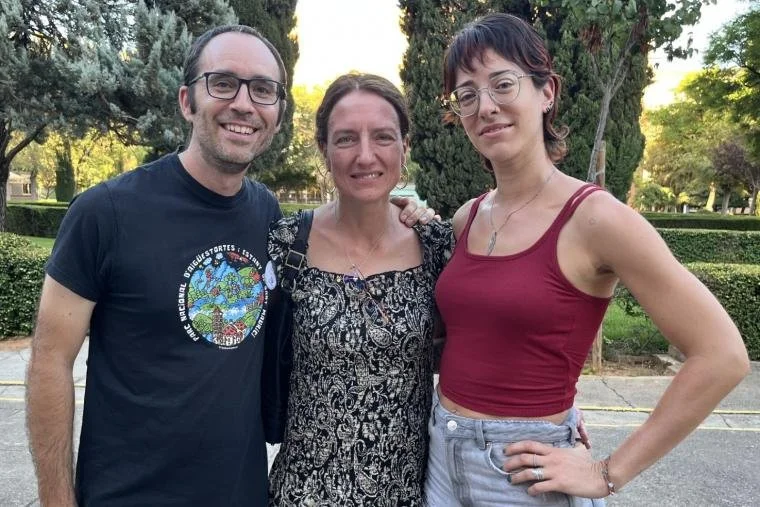
Guest editors (from left to right: Juan Diego Ibáñez-Álamo, Judith Morales, Elisa P Badás)
The main takeaway is that human-induced environmental change profoundly shapes avian reproduction, but in complex ways. Many studies highlight negative consequences, such as reduced reproductive success, altered mating behaviour or physiological stress, while others show that some species can adapt or even benefit from novel conditions. We also learned that we should be careful in the interpretations of the observed patterns, since we still need integrative approaches that combine long-term data, experimental work and broad-scale analyses to fully understand the adaptive potential of birds in a rapidly changing world. Another interesting conclusion is that diverse perspectives from researchers across different regions of the world can be very valuable to increase our understanding of global environmental changes associated with human activities.
What was your experience of the editorial process? Were there any challenges or unexpected insights?
There was no major difficulty, and this was thanks to the excellent support of the JAB editorial team (Michael Tobler, Jan-Åke-Nilsson and Staffan Bensch) and to the great connection between the three guest editors. The main challenge was to deal with delays in manuscript submission and our own deadlines, but this was greatly compensated by the overall quality of the contributions we received and by the final outcome.
Judith, you are a regular editor of Journal of Avian Biology. Was there a difference between being a regular subject editor and a guest editor of a special issue?
The experience of being a guest editor of a Special Issue felt quite different from the usual role of subject editor. It gave me a stronger sense of involvement —it felt like “our” issue, developed in our own way— and also a certain freedom to choose the topic and shape the collection as a whole.
Has working on this special issue influenced your own research or perspectives on avian reproductive ecology?
Working on this Special Issue has certainly broadened our perspectives on avian reproductive ecology. As editors, we were struck by how different the responses can be to similar environmental challenges, and by the many new questions that these insights open up. For each of us, the experience has reinforced the importance of collaboration and of looking beyond our own study systems to gain a fuller picture of how birds respond to human-induced environmental change.
Are there data or approaches that are still lacking to better understand the effects of human-induced changes on avian reproduction?
Many of the open questions in the field can only be addressed through long-term and integrative approaches, combining behavioural, physiological and ecological perspectives, as we suggest in the Editorial article. Also, the issue calls for further experimental research to establish the causal mechanisms that influence the responses to environmental change and evaluate long-term effects. Finally, there is a need to explore the effects of human-induced environments throughout ontogeny to reveal, for example, how early-life conditions shape adult reproductive behaviour.
Journal of Avian Biology—who are we?
JOURNAL of AVIAN BIOLOGY: Empirical and Theoretical Research in Ornithology is an Open Access journal owned by the Nordic Society Oikos.
We are a journal for innovative, hypothesis-driven research on the biology of birds, with a particular emphasis on ecological, evolutionary and behavioural studies. We welcome submissions that study avian biology across all levels of ecological organization, from organisms and populations to communities and ecosystems. The journal also welcomes studies that report negative results, provided they are conducted rigorously and are scientifically informative. As a Nordic Society Oikos journal, we advocate research that is fair, openly accessible and reproducible.
Thinking about publishing with us?
Journal of Avian Biology offers a Review Award for early-career researchers.
We value ethical standards in science (EDI, Open Access, waivers, accessible data and code, CRediT)
Check out JAB’s journal metrics and see our Author Guidelines
Our journals, our society—join us!
The Nordic Society Oikos engages the global scientific community through five international journals…
…and supports the national ecological societies of the five Nordic countries. Anyone worldwide can join the Nordic Society Oikos.
NSO is a home for ecologists, a nexus for knowledge, and a guiding light for ecology worldwide. We are an active network of ecologists in the Nordic region and around the globe.
Why join NSO? Membership benefits include:
Connections across a global community of ecologists and five national societies
NSO newsletters with member-only updates about Nordic ecology and society activities
Ongoing opportunities for promotion on NSO’s digital platforms and social media channels
Discounted registration for NSO’s biennial conference
Eligibility to apply for NSO Grants
Each member receives additional benefits from one of our five national societies:
Danish Oikos Society
Oikos Finland
Icelandic Ecological Society
Norwegian Ecological Society
Swedish Oikos Society
When you join NSO, you also become a member of one of our national societies. Which one? That’s up to you! Each national society provides its own benefits, including discounts to national conferences. Learn more about us at nordicsocietyoikos.org.