
Study | Migratory divides highlight intraspecific flexibility in the stop-over tactic of black kites
Different routes, different foods: how black kites adapt their migration strategies
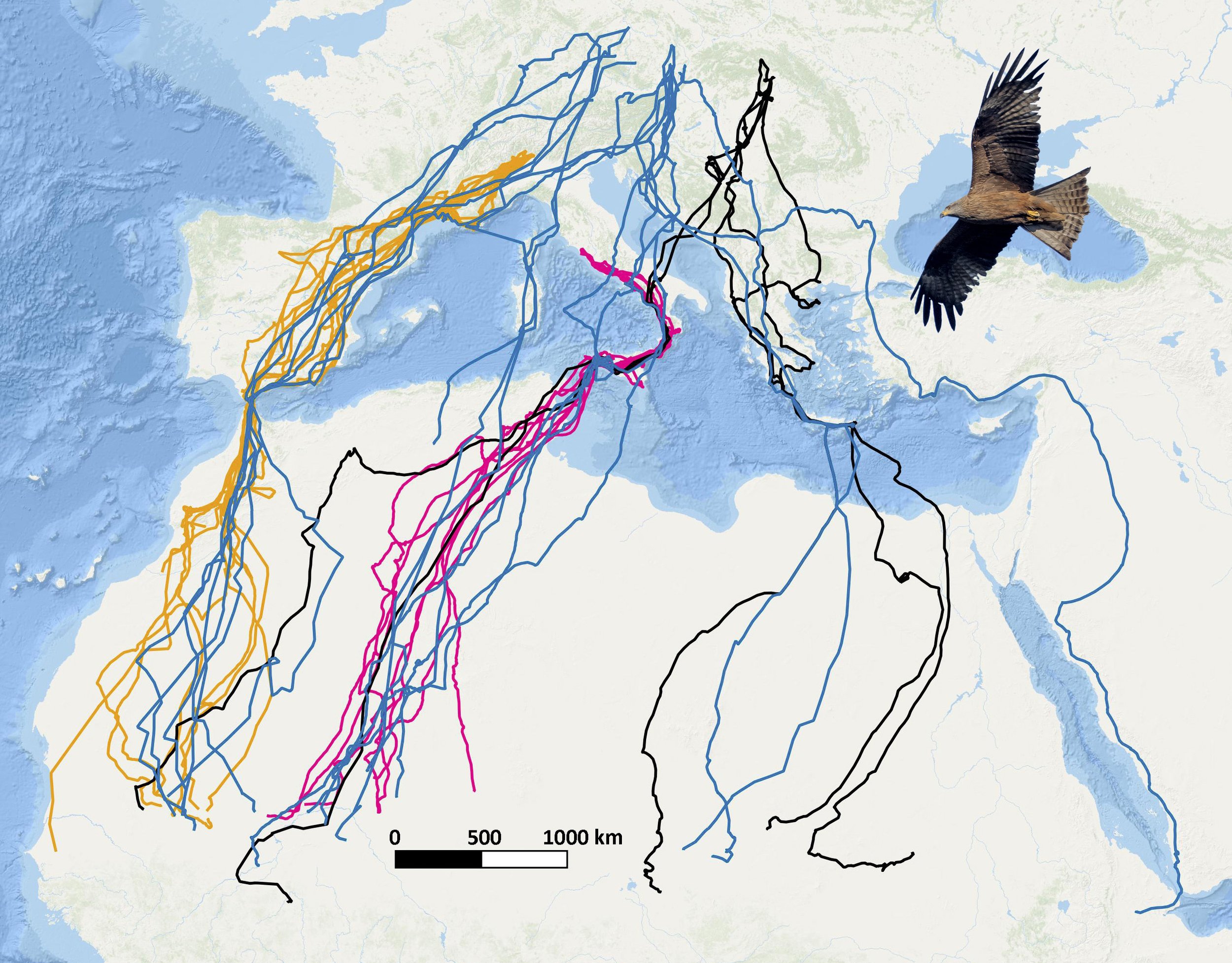
Figure 1 from the article: Routes followed by 43 juvenile black kites during the first outbound migration. The four breeding areas in which birds were clustered according to their hatching location are highlighted by the track colour: yellow (northern Italy), blue (Czech Republic), purple (central Italy) and black (Slovakia). The photo shows an adult individual. Photo (c) Ugo Mellone.
Text and photos by Ugo Mellone
Migration is not simply a matter of getting from one place to another. For birds travelling across continents, the route they take can determine where they stop, how long they stay, and what food they rely on along the way.
Among long-distance migratory raptors, species that rely predominantly on soaring flight, such as eagles and vultures, can often accumulate sufficient energy reserves to cover substantial parts of their journeys without feeding, or with only limited foraging. In contrast, species with more mixed flight behaviour, such as harriers and falcons, generally combine active flight with foraging, dedicating hours or days to stopovers. Although black kites rely heavily on soaring flight during migration and concentrate at major bottlenecks to avoid long water crossings, they are also frequently observed foraging en route. Their foraging tactics can be surprisingly flexible, even among birds following the same flyway.
Different flyways, different strategies
In our study we tracked 43 juvenile black kites from breeding areas in the Czech Republic, Slovakia and Italy, using GPS/GSM transmitters to follow their first migration towards Africa. The birds crossed the Mediterranean along three main flyways, and their route choice was largely linked to where they had been born.
Birds from Northern Italy consistently followed the Western Mediterranean route, crossing through France and Spain towards the Strait of Gibraltar. In contrast, birds from central Italy headed almost directly south, crossing the Sicily Channel. Birds from Central Europe showed greater variation, with individuals using western, central or eastern routes depending on their breeding location.
This geographical divide reveals just how strongly the complex geography of the Mediterranean basin can shape migration. Different populations can reach tropical Africa while taking remarkably different paths.
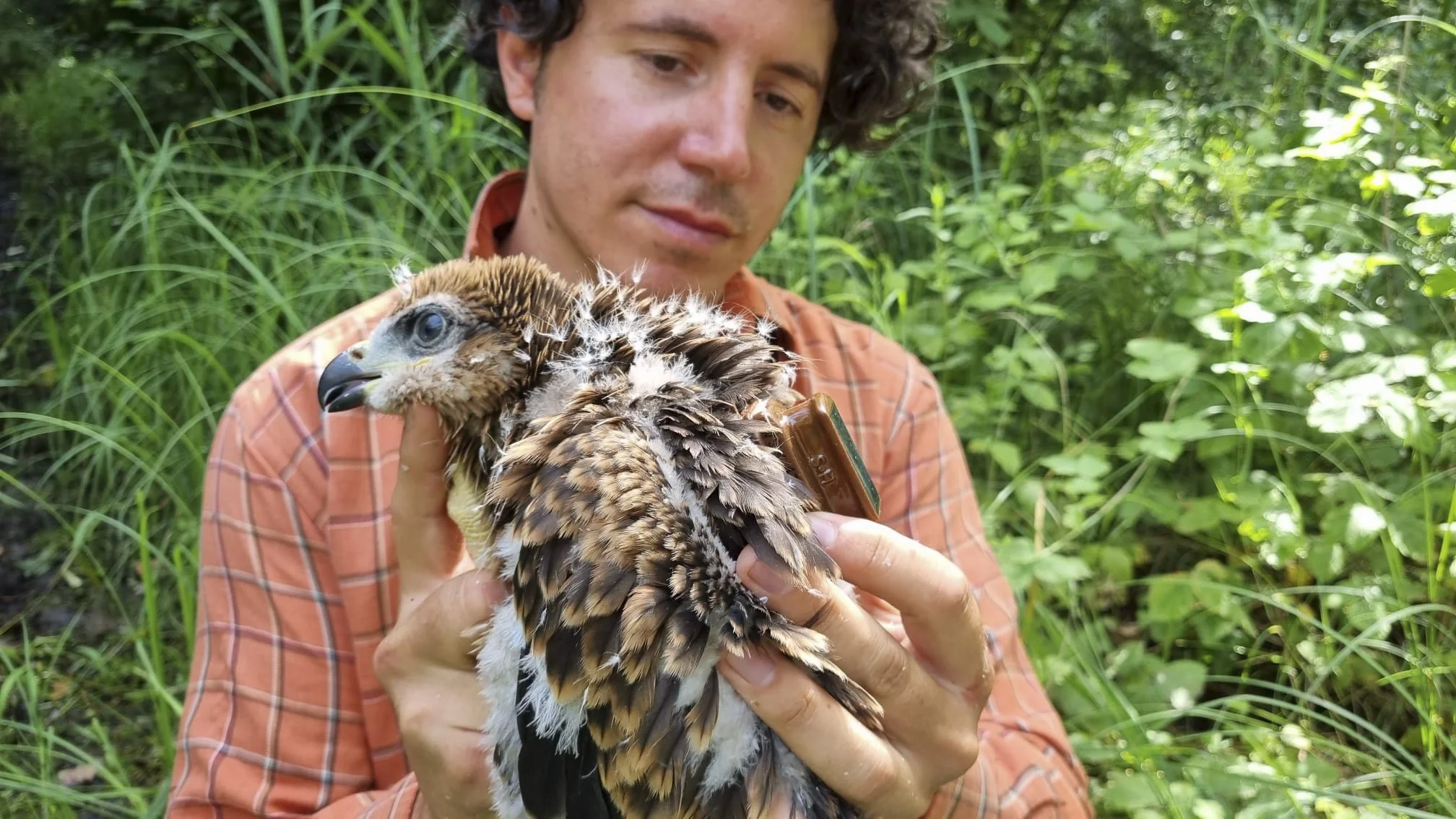
Michelangelo Morganti handling a juvenile black kite. Photo: Ugo Mellone.
“These results highlight the remarkable flexibility of black kites. The species is an opportunistic feeder, and individuals appear capable of switching between very different food sources depending on what is available along their migratory route.”
One species, many stopover strategies
However, the most interesting differences emerged when we looked at what these young kites did along the first journey. Birds following the western route showed strikingly different stopover behaviour depending on their breeding origin. Northern Italian kites made extensive use of landfills in France and Spain, taking advantage of predictable anthropogenic food sources. Czech birds, despite travelling partly through the same regions, mainly stopped in agricultural and more natural landscapes. Along the central Mediterranean route, birds crossing the Sicily Channel (coming from Central Italy, Czech Republic and Slovakia) spent up to three or four weeks in Sicily, but rarely concentrated their activity around landfills. Instead, they moved across extensive agricultural areas, apparently exploiting naturally available food resources.
Sicily: a stopover buffet
Why would black kites spend weeks in Sicily without relying heavily on landfills, when these food sources are available? One possibility is that the landscape provides an exceptionally profitable natural alternative. During migration, large numbers of black kites have been observed gathering in the area, apparently taking advantage of high concentrations of small crickets (Grylloderes brunneri). For a bird preparing to cross a major ecological barrier such as the Mediterranean Sea, a reliable pulse of natural prey could provide an abundant and accessible source of food before continuing its journey.
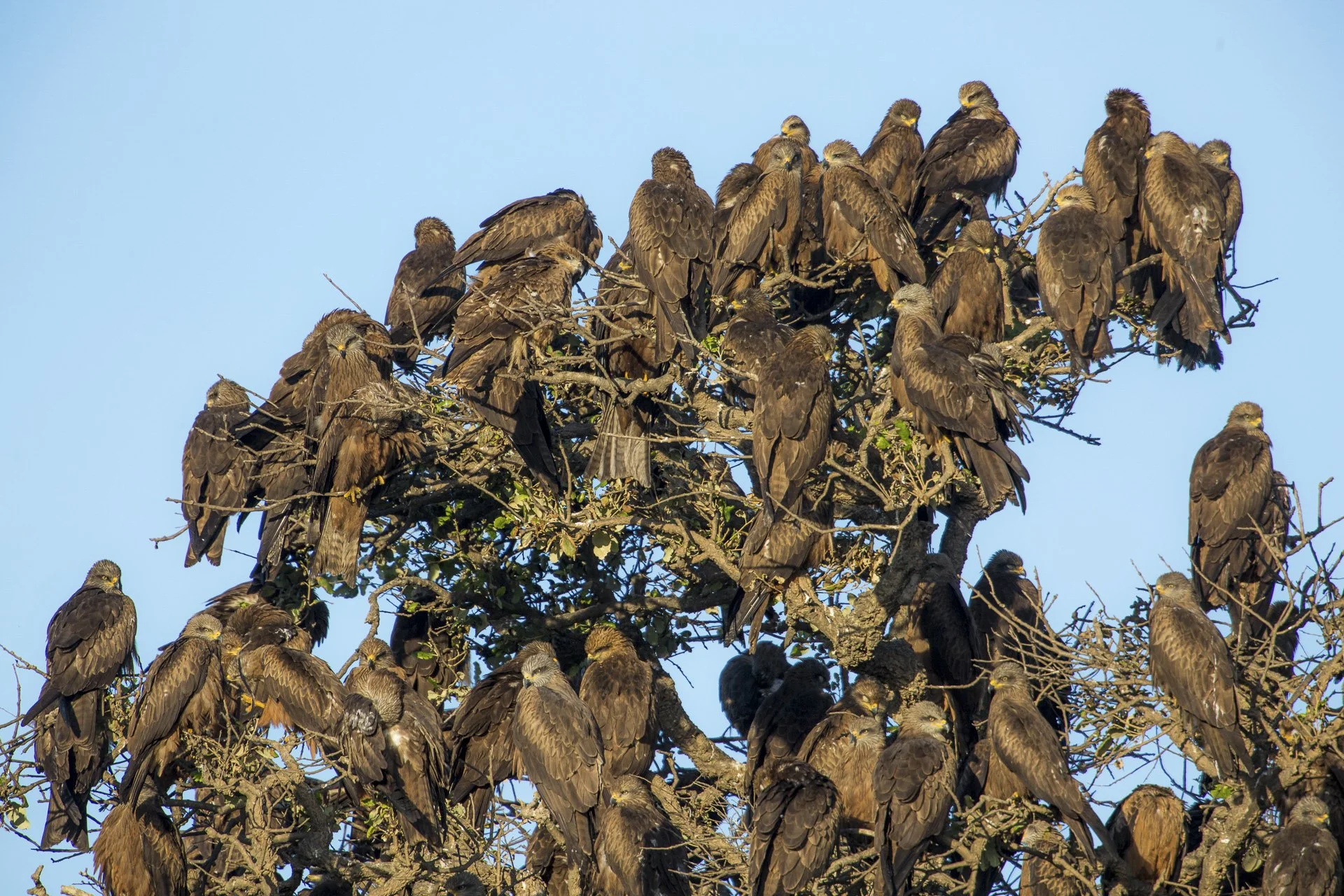
Black kites roosting besides a landfill in Southern Spain. Photo: Ugo Mellone.
Flexibility may entail a price
These results highlight the remarkable flexibility of black kites. The species is an opportunistic feeder, and individuals appear capable of switching between very different food sources depending on what is available along their migratory route.
But relying on human-generated food is not necessarily harmless. Landfills can provide abundant and predictable resources, yet the food available there may also expose birds to pathogens, plastics, pollutants and other contaminants. Such risks may extend far beyond the populations living close to these sites, because birds can carry the consequences of their feeding habits across continents.
This makes the relationship between migration and foraging particularly important. A bird breeding hundreds or thousands of kilometres from a landfill may still be exposed to the risks associated with it during migration.
An opportunistic long-distance migrant
Our study does not show that black kites actively prefer or avoid particular habitats, since the availability of landfills and other resources was not quantified along the different flyways. However, it reveals striking differences in where and how long birds stop during migration.
The same species can therefore rely on very different strategies: from short stops at anthropogenic food sources, to prolonged stays in agricultural landscapes rich in natural prey.
Migration is often portrayed as a fixed journey between breeding and wintering grounds. In reality, black kites show that the journey itself can be remarkably flexible, shaped by geography, population origin and the resources that birds encounter along the way.
Journal of Avian Biology—who are we?

JOURNAL of AVIAN BIOLOGY: Empirical and Theoretical Research in Ornithology is an Open Access journal owned by the Nordic Society Oikos.
We are a journal for innovative, hypothesis-driven research on the biology of birds, with a particular emphasis on ecological, evolutionary and behavioural studies. We welcome submissions that study avian biology across all levels of ecological organization, from organisms and populations to communities and ecosystems. The journal also welcomes studies that report negative results, provided they are conducted rigorously and are scientifically informative. As a Nordic Society Oikos journal, we advocate research that is fair, openly accessible and reproducible.
Thinking about publishing with us?
Journal of Avian Biology offers a Review Award for early-career researchers.
We value ethical standards in science (EDI, Open Access, waivers, accessible data and code, CRediT)
Check out JAB’s journal metrics and see our Author Guidelines
Our journals, our society—join us!
The Nordic Society Oikos engages the global scientific community through five international journals…


…and supports the national ecological societies of the five Nordic countries. Anyone worldwide can join the Nordic Society Oikos.
NSO is a home for ecologists, a nexus for knowledge, and a guiding light for ecology worldwide. We are an active network of ecologists in the Nordic region and around the globe.
Why join NSO? Membership benefits include:
Connections across a global community of ecologists and five national societies
NSO newsletters with member-only updates about Nordic ecology and society activities
Ongoing opportunities for promotion on NSO’s digital platforms and social media channels
Discounted registration for NSO’s biennial conference
Eligibility to apply for NSO Grants
Each member receives additional benefits from one of our five national societies:
Danish Oikos Society
Oikos Finland
Icelandic Ecological Society
Norwegian Ecological Society
Swedish Oikos Society
When you join NSO, you also become a member of one of our national societies. Which one? That’s up to you! Each national society provides its own benefits, including discounts to national conferences. Learn more about us at nordicsocietyoikos.org.